Thursday, June 28, 2012

1.16. Paying the Entrance Fee

DoD surveys The Twin Emperors,
The Temple of Ahn'Qiraj

Options Dry Up

Attempts on Twin Emperors were not going well at all. One week earlier, the 40-Man raiders had successfully exterminated Princess Huhuran, earning the first set of "real" rewards in the instance. From Skeram up through Fankriss, loot was on-par with that of Blackwing Lair (for the most part). Blizzard tried something new with Ahn'Qiraj: instead of issuing our set pieces directly from the corpse of a boss, we'd collect tokens to be exchanged for the actual gear. These Qiraji Bindings were shared among multiple classes, which added a layer of complexity to our fixed-cost DKP system. It was already an administrative nightmare to catalog every item, estimating its worth to a particular class. Now we had to consider the value of the exchanged item, normalizing the cost between the classes that shared it. Players regularly dismissed their assigned loot, opting to pick-and-choose random off-pieces to maximize their play -- which only made the administration worse. The good news is that we finally had some Tier 2.5 tokens to our name, thanks to the death of Huhu...

...the bad news is they would be the last AQ tokens that Descendants of Draenor would see.

The problem of AQ40 was becoming more painfully clear upon each wipe at the hands of Emperors Vek'lor and Vek'nilash. First and foremost, we'd run out of time on the schedule. B-team became more prolific at leaving us "cleanups" as they failed to empty out Blackwing Lair. Instead of starting AQ40 work fresh, A-team continued to sink precious minutes into Nefarian kills before moving to Silithus. And, A-team themselves had issues with farm bosses. Our first kill of Skeram was months behind us, yet we still struggled with execution, and the same held true for Battleguard Satura. We regularly skipped the bug family to shave time off clears; the change was negligible. Even a mistake or two on Fankriss meant re-doing the gauntlet that proceeded him. Let us not forget about The Princess whom had already proven to us she was going to require multiple attempts per night; the self-proclaimed queen of the 1% wipe. After A-team swallowed all of that, precious few hours remained to work on The Twin Emperors, and we were only now digging into the tough content. For behind The Twin Emperors nestled Ouro and Viscidus (both of whom could be skipped) and the ultimate evil behind all of Ahn'Qiraj: C'thun. We'd heard the horror stories of world-first guilds burning week after week after week on the final boss. Two days a week was no longer enough.

So, there was the problem of time; a lack of a viable schedule. There was the problem of loot, that being nearly every boss we were killing en route to The Twin Emperors producing nothing of upgrade value. There was the looming expansion, still in development by Blizzard but in the forefront of our minds every day. A release date wasn't yet set in stone, but we predicted that it would be soon, and we wanted as much off our plates as we could stand.

And, of course, there was the issue with Naxxramas.

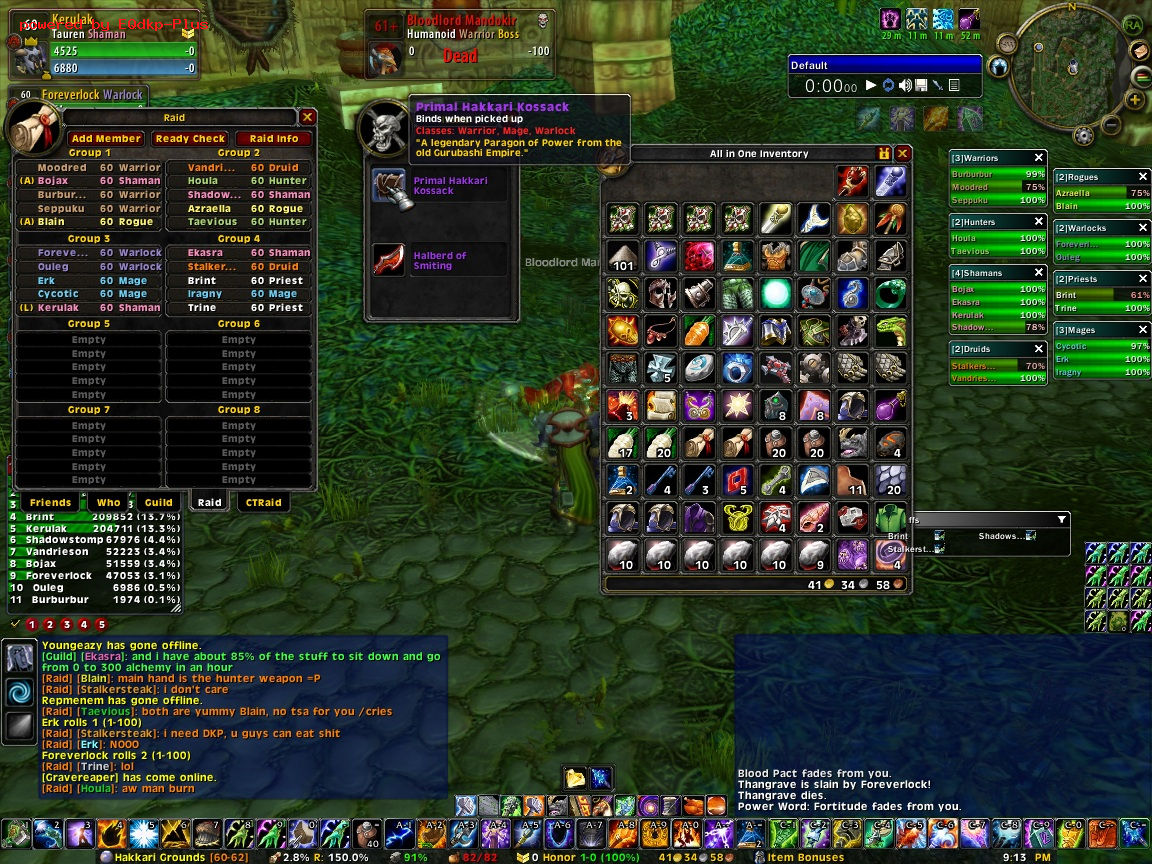
Kerulak and the 40-Man team gets Power Word: Fortitude
in preparation for the nightly work in Naxxramas,
Eastern Plaguelands

2.5 vs. 3.0

An entire raid instance still existed that we hadn't even set foot in. The ultimate raid in Vanilla, a devastatingly oppressive instance that only the dedicated few raiders of World of Warcraft could claim a victory over. We knew by pouring over the Elitist Jerks discussions and examining the loot tables buried within thotbott.com that Naxxramas was, coin-for-coin, worth every bit of energy put into it. Items that dropped off the first bosses alone put our existing gear to shame, and with most players in A-team built on Tier 2, the prospect of leap-frogging out of AQ40's pathetic 2.5 side-grades straight into Tier 3 made our core raiders drool with anticipation.

The only other possibility to increase our progress was to come to an agreement with a competing guild, one less progressed than us. These less progressed guilds whom were able to clear the first half of AQ40 were starting to "give up" their raid locks to more progressed guilds, who would swoop in, inherit the half-cleared instance, and then power through the remaining second half. The price on the "sale" of these locks varied from handfuls of gold, and/or promised loot if it dropped, to "carrying" several of the lesser-progressed-guildies along for the ride. None of these options sat well with me. They all seemed like forms of selling out. Could we actually say we cleared AQ40 if others were doing half the job for us? It didn't matter what I thought, anyway. There were no half-eaten AQ40 raid locks to assume on Deathwing-US. Whatever inter-guild agreements may have been on-the-table got scooped up by other guilds with greater desperation and less conscience.

After The Twin Emperors made it clear we would be spending weeks working on their encounter, and with our options dwindling, the officers and I came to a difficult decision: Our work in Ahn'Qiraj was over. Princess Huhuran would remain the final boss defeated by Descendants of Draenor in AQ40, and all of our efforts would now be turned towards the necropolis that floated above the Eastern Plaguelands.

Some of the officers didn't take this news well. Kadrok was particularly angry by this decision, and felt his voice hadn't been heard enough. An old school EQ player, he was unsatisfied with an incomplete instance on our track record. Trying to outline the logical reasons why we left AQ40 only reiterated to me that it was a decision not made lightly. But as an honorable officer, Kadrok bit his tongue and stuck to the assignment, continuing to lead and shape the Shamans into a respectable crew of healers. I encouraged him at every opportunity I could, but I could tell he was not pleased with leaving AQ40 behind. I wished there was a way that everyone could be happy. There wasn't. And for those of the raid team who couldn't stand AQ40, celebrating our decision with virtual backflips, Kadrok and like-minded completionists only grew more disgusted at our choice to throw in the towel.

Kerulak takes some flak from a non-raiding player,
Orgrimmar

The Need For a Gate

Before we set foot in Naxxramas, we needed all of our players to gain access, a process known as "attunement". Molten Core and Blackwing Lair both had an attunement that was easily digested: run a long dungeon and collect a quest item at the end. AQ40, meanwhile, had no attunement whatsoever (save the server-wide unlocking of the entire instance). But Naxxramas had a different plan in store for us. Stationed in Light's Hope Chapel stood a series of NPCs revealing the attunement quest to us. There was no challenge, no dungeon to run or quest item to return -- in fact, the attunement was completely free...

...if you were exalted with The Argent Dawn.

Now, if it turned out that you hadn't run 10-Man Stratholme or Scholomance a billion times already, no problem! You could also gain access to the floating necropolis for a small fee of 30 gold if The Argent Dawn saw you were at least Revered. Even those who were only Honored could buy their way in, though the cost was raised to 60 gold for these less dedicated folks.

Let me take a moment to propel you back into a game where having gold was practically unheard of. In those days, there was no such thing as a daily quest -- a quest you could repeat over and over, racking up vast amounts of wealth. In Vanilla, once you walked the entire surface of Azeroth, completing every quest in every zone, quests no longer became your primary source of income. From that point on, money came from either playing the Auction House, or farming high-level mobs until your eyes bled. And when carrion grubs in the Plaguelands dropped 2s each, it was a long, hard road to 30g.

The grinding became so incessantly awful that I often forgot why I was there in the first place, gaining temporary bursts of insanity that caused me to make bets with myself on what I would hit first, the reputation or the gold cost. In a burst of craziness, I'd scribble down some notes on how fast I thought I was earning reputation, then compare it to the insanely low income of mob farming. Gold...it was definitely going to be the Gold that wins out. Ha ha! I told you, game. I told you!! I'm totally going to get the gold before I max my rep. 

Reality would quickly snap back like a bucket of water being dumped on me as I sat at the computer. What the fuck was I doing? Was this why I swore never to touch another MMO again? Why hadn't I listened to myself? Who considers this 'fun'? Didn't I learn my lesson in EverQuest?

"If they know what's good for them, they'll ditch any and all concepts of attunement in the expansion", I typed into guild chat.

"They do it to gate the raid," Kadrok replied, "Not everyone belongs in there."

"Nor should they be! But for God's sake, can't the player's skill...or lack thereof....be the gate itself? There has to be a better solution than this."

"They should just do it off of your gear", typed Gutrippa, adding to the conversation.

"Yeah, exactly! This makes perfect sense. Examine a person's gear. If you don't have the gear, don't let people in the instance!"

Blain typed his two cents into guild chat, "Gear doesn't make a bad player good tho."

In that brief moment of lucidity, the Naxxramas attunement made sense. For all the technology that WoW was bringing to the table, a good ol' fashioned grind was the most practical way to keep non-raiders at bay. A casual would look at a grind like that and give it the middle finger. There'd be no complaints of 'the instance is too hard', or 'we can't figure out these bosses', because players who used those excuses as a crutch wouldn't even get a taste test. The rest of us might bitch to ourselves quietly...but then knock it out. Besides, players that didn't raid had other opportunities to take their jealous rage out on us, spitting on us in public at the sight of our gear. A /spit is much easier than, say, getting off your ass and making it happen. They were unwilling to pay their entrance fee like the rest of us. Those players would always exist, but the logistics behind these gates diminished their opportunity to bitch. Of what little animosity that remained towards our progress and success, we ate.

---

I won my own bet: the 30 gold pieces accumulated first. To this day, Kerulak is still not exalted with The Argent Dawn.

Thursday, June 21, 2012

1.15. Fumigation

Kerulak gets a 466 "critical" on the second
jump of a Chain Heal circa Vanilla,
Zul'Gurub

Insane Carpenters

"What the fuck is making my system so slow?" one of the players typed into guild chat.

"My framerate is shit, rebooting. BRB" typed another.

I glanced down at officer chat. The whining was no less muted.

[Officer][Dalans]: This mod is a pig.
[Officer][Blain]: Just deal with it.
[Officer][Ater]: Make sure you have the latest. Couple of the other mods might conflict.

The A-team clearly had a very vocal opinion on RDX. They thought it sucked.

"Why do we even need this mod?" asked Cycotic, one of our Mages.

"In order for a lot of the raid-checks to work, everyone has to have it. The mod communicates data back and forth through specific chat channels to let us know who's repaired, what resistances you're at, whether or not you have health and potions. That sort of thing. It also helps us decurse."

Cycotic ignored the entire first part of my explanation, "Yeah, but I don't need to decurse."

I took a deep breath. Technically, you do; you're a Mage, but because you're also a moron that hyper-focuses on your damage to the exclusion of everything else, you don't think you need to decurse. The explanation never left my lips. Speaking aloud into Ventrilo would have no effect. We'd explained Mage decursing time and time again, but the Mages just didn't get why they had to do it. And they weren't alone. A lot of players didn't "get" why we had to do anything special, use any add-ons, perform abilities not essential to their damage rotation. Even in the face of our successes from continued streamlining, they clung to their old ways, defiant and stubborn. And it wasn't just the junior ranks that were guilty of this.

I clicked a button on my UI that Ater had shown me, one that would ping all the players in the raid and report back their version of RDX. Annihilation was still absent from the list.

"Anni, are you having a problem installing RDX?"

"I told you guys, I don't use add-ons!"

"You can disable all the frames, but we need it installed on everyone's system so it can communicate the other bits of data from the raid back to us." We were using different words to say the same thing, over and over.

He logged off and jammed the mod into his add-ons folder as directed. Officers needed to lead by example; I couldn't have any of the leadership bitching publicly about our new requirements. But, in Anni's style, he preferred to speak rather than type, so it was immediately out in the open on where he stood on RDX. Hearing that, members of the A-team continued to rag me about it. The insane carpenters insisted on using their bare hands instead of hammers. It made absolutely no sense to me at all. I thought we had put this behind us. I was wrong.

Annihilation logged back on. I clicked the button to report back RDX versions; this time, Annihilation passed the check.

"Wow!" he exclaimed loudly in Vent, "my system performs like shit now!"

Ventrilo lit up with laughter from the group.

The group, minus me.

Kerulak, en route to Princess Huhuran,
The Temple of Ahn'Qiraj

Princess Huhuran

The nature soak group was still shy of where we needed it to be, but Blain insisted that we get started. The giant olive-colored wasp hovered in the center of her cave, her wings speckled with dots of red. We reviewed the strategy. Princess Huhuran called for a group of ten players to encircle her, maintaining a close distance throughout the fight. The reason being: these ten players would be subjected to an AoE sleep via her Wyvern Sting. Even the Tanks weren't immune to this. Gear with a high NR rating would provide us with the chance to get a binary resist, but if not, we couldn't blindly decurse the effect. Doing so would immediately cause a spike of damage on the player decursed. Tanks were the only reasonable decurse targets in this encounter, the rest would have to eat the sleep.

Huhu's primary attack on the tank was Acid Spit, a stacking DoT that was completely unresistable, forcing us to employ a Tank rotation. But, for one of the first times in our raiding career, Princess Huhuran was an untauntable boss. A tank rotation was no longer just as easy as calling out, "OK take it from me!", followed by the press of a single button. The tanks had to be ultra disciplined in managing their threat, paying close attention to KTH Threat and performing their most efficient rotation of abilities. There were no Tricks of the Trade in Vanilla, no Misdirects...and without taunt, the management of threat rested solely on the skill of the tank. Use the wrong rotation and you'd fall so far behind that there'd be no way to peel Huhu off of a Tank loaded up with DoTs.

Along with Wyvern Sting AoEs and a handicapped Tank rotation, Huhu would enrage throughout the encounter, forcing the Hunters to once again coordinate a Tranquilizing Shot rotation. Blizzard wasn't making this easy on us by any means. Those mechanics combined were more than enough to keep the raid fully tasked, yet Blizzard had one more trick up their sleeve. At 30% health, the nightmare began. Princess Huhuran would begin her Poison Volley in a last ditch attempt to wipe us. Every three seconds she remained alive, the enormous wasp would barrage the closest fifteen players with poison damage, to the tune of 2000 nature damage. As players dropped, new players with Nature Resistance needed to move in, keeping the soak team alive, which added precious seconds to our attempt.

The princess was a gear check, a skill check, a discipline check, and a communications check -- in short, she was a real litmus test of our ability as a progression raid team in Ahn'Qiraj. Making it up to Huhu was a walk in the park; it was well-known that less progressed raid teams were starting to clear Skeram through Fankriss. Making it past her would be another opportunity to define us.

DoD defeats Princess Huhuran,
The Temple of Ahn'Qiraj

Pesticide

The numbers on Poison Volley scared the proverbial shit out of me. My chain heals were averaging between 400 and 500 per cast, at a cast time of a flat 2.5 seconds -- back then, there was no Haste to speed casts up. Meanwhile, Poison Volley obliterated player health. At 2k a pop, my own pathetic health pool that barely broke 6k would be depleted in 6 seconds. Even if I were targeting myself, back-to-back chain heals would grant me a whopping one additional second of life. That meant that I, along with others who had no Nature Resistance, were not the priority -- self-preservation was off the table. The task at hand: those with the highest nature resistance absolutely had to be kept alive for as long as possible. That meant nearly non-stop chain heals, and practically no time to sit on the 5-second rule. Everything I could do to keep my mana pool up was vital.

I cannot begin to recount how many 1% wipes we had on Princess Huhuran. Players dropped like flies in the last 30% and trying to keep them up was like playing Whack-A-Mole in Hell. Since the stronger single-target healers were assigned to keep the Tanks alive, it was up to us Shamans to FFA heal, keeping the remaining roles alive for as long as possible. It wasn't easy. The tiny health pools of Vanilla coupled with the insane brutality of the nature damage involved meant that if you saw a player spike, it meant they didn't have the nature resistance necessary -- but instinctively, you wanted to save their life by winding up a heal...only to have them fall over dead before the heal was cast. With Lesser Healing Wave too inefficient, and Greater Healing Wave too slow, my only option was to down rank Chain Heal, pick a target I knew would survive more than two seconds, and stay disciplined on them.

A difficult prospect for a player like me, prone to panicking, spazzing out on any and every button available.

At the end of the second weekend, on the third night of attempts on the Princess, players once again expired at a rate I couldn't keep up with. I healed as long and as hard as I could until my Mana pool was nearly exhausted, and then I joined the dead. The RDX health bars emptied out, and Huhu's unit frame drew down to 3%....2%. Players alive dropped into the single digits. Six alive...five....four. Huhuran's health dropped to 1%. Three players alive. Two players alive. The enormous fly flipped over onto its back, its legs twitching as the ganglia got its final shots from a dying nervous system.

With only two players alive, the Princess's reign was over.


Thursday, June 14, 2012

1.14. Streamlining the Approach

Kadrok chalks up another Vaelastrasz kill,
Blackwing Lair

A and B

At the 10 month mark, I'd been present for the first kill of every boss from Lucifron through Battleguard Sartura. As August approached, so too did vacation time. I'd pile the kids into the car and take them far into the Canadian north, up to Grandpa's farm. This would be the third trip; the summer of 2004 was the first, when WoW was still in beta. We made the second trek again in '05 when the most exciting prospect on DoD's plate was a full clear of Upper Blackrock Spire. Now in 2006, DoD was in full effect, making weekly clears of Molten Core and Blackwing Lair, and our reputation had allowed us to grow to the point where we were fielding two complete 40-Man raid teams per week. The logistics behind it were insane, but Ater was always finding new ways to streamline our weekly raids. In order to make it work, he continued to layer on efficiency.

At first, we drew Molten Core out into a single clear in one long evening, split among two separate raid teams -- both of which shared a small core of officers. The first half of the night would be the newer, less geared raiders in the guild, and Ater would run them from Lucifron through Baron Geddon. He would be no less strict with this "B-team"; he pushed those under-geared starters through like a drill sergeant at boot camp. All the while, he dangled the carrot in front of them, "We're swapping the next group in at the two hour mark," he said to them, "so if we don't get through Geddon, you'll lose out on that loot." They did everything in their power to squeeze out those first five bosses in two hours, wearing their crappy gear. As promised, when the two-hour timer was up, he'd announce the swap, which is when I would tag in with another contingent...the core raiders who had cut a path through raid content for the guild. The folks responsible for the first boss kills and painful weekends of wipes while perfecting new strategies -- this group became known as the "A-team".

Once A-team was locked and loaded, the guts of the Core exploded in a fine paste in our wake. We made short work of Shazzrah, Sulfuron, Golemagg, Domo and Rag, and moved quickly up through Blackwing Lair, clearing as much as we could in the remainder of the weekend, nearly always securing a Nefarian kill. In those days, having a boss on farm wasn't always a guaranteed kill. Sometimes RNG just didn't work out. Sometimes Nefarian simply didn't want to play nice. But for the most part, we got work done, and A-team inched closer to the more difficult raid content yet untouched.

As time went on, and A-team spiraled down below the surface of Azeroth, working our way through insects rather than dragonkin, time grew short to clear Molten Core and even Blackwing Lair, so Blain drew a line in the sand and stated that in order to keep progressing deeper, we'd need more time to devote to AQ40. So, A-team no longer swapped in for Molten Core, leaving B-team team to fend for themselves against the ancient Fire Lord. When it came time to have them clear the start of Blackwing Lair, I worried the complexity would brick-wall them, as it had done to us. To soften this blow, I created a series of training videos to help educate them. I produced videos for Razorgore, Vaelastraz, Firemaw, Ebonroc and Flamegor...and even created videos to train them on various trash mobs -- namely, the Death Talon and Lab packs. Soon, B-team was clearing up to Nefarian, and A-team's weekly AQ40 raid either had a "cleanup" prerequisite or not; "cleanup" meaning we were responsible for killing B-team's Nefarian before doing our own work in AQ40.

The raid mocks Kerulak during the second
kill of Fankriss the Unyielding,
The Temple of Ahn'Qiraj

Where's Kerulak?

Ater, along with my Shaman officer Kadrok, were the ones primarily responsible for the success of the B-team clears each week. B-team was vital, as it produced more quality players to be inducted into A-team, but both Ater and Kadrok had another dark secret for running the Core until their eyes bled...both needed components for their legendary weapons. Kadrok sought the Eye of Sulfuras, while Ater had his mind set on Bindings of the Windseeker, dropped by Garr and Baron Geddon. Their luck wasn't as good as some other guilds. Week after week they coordinated and led the B-team through Molten Core in search of the coveted drops -- and each week they would come up snake eyes. Long after the officers and I were done with Molten Core and BWL, fending off wife-aggro or other excuses to not be there for the guild, Ater and Kadrok returned for more insanity, pushing B-team further each time, setting the stage for the A-team in our quest to dig deeper into AQ40. Their farming continued in vain, and eventually, Kadrok threw up his arms in exhaustion and removed himself from the B-team rotation, leaving Ater to fend for himself in the Core.

Meanwhile, Blain had already put our next assignment on the table: farm nature resistance gear in preparation for Princess Huhuran. She was still a boss away, nestled quietly behind Fankriss the Unyielding, but we needed to build a solid nature soak group, so our off hours were spent grinding away reputation with the Cenarion Circle. You could only do this a few ways during Vanilla: run the 20-man raid The Ruins of Ahn'Qiraj, or spend an exorbitant amount of time farming Twilight Cultists in Silithus. This rep grind was only slightly augmented by our work in AQ40, generating a tiny bit of reputation in the process. When not performing these tasks, we were carefully watching every piece of green loot that dropped in our weekly clears -- anything having a remote amount of nature resistance on it was cycled to the guild bank, Oxanna, to be re-distributed to members in A-team for soak purposes.

The farming progressed slowly, and we did some initial work on Fankriss...but our first attempts didn't quite close the deal. Things would fall apart near the end of the encounter. The Spawn of Fankriss had to die in 20 seconds or it would enrage, and the longer you drew the fight out, the greater the chance of a Spawn eating one of your tanks for breakfast. Less tanks meant less Vekniss Hatchling control and...well, you see where I'm going with this. Fankriss was your typical attrition-style boss fight. If your raid can't keep up, eventually, you'll be overwhelmed and die. We were close, but close only counts in horseshoes and hand-grenades, and I wished the A-team the best of luck as I headed up north for my vacation.

As luck would have it, it was the weekend I took off for summer vacation that would produce our first kill of Fankriss the Unyielding, making it the first boss kill I'd miss since starting our 40-man raid team 10 months earlier. Luckily, the raid team did a good job to both capture a screenshot of that kill, and make me feel guilty for missing it -- for the next several months to come.

Everyone in the raid team is a comedian.

Kerulak adjusts his UI, working
RDX into his list of add-ons,
Zul'Gurub

RDX

When I got back from my summer vacation, Ater had another efficiency waiting for me.

"I'd like the raid to try this mod out. It's insane."

Up until this point, we'd been using a multitude of mods: CT_Raid, Decursive, Recount...to name a few. And they worked reasonably well, augmenting our ability to change our healing targets quickly, cleanse players of debuffs, and see how far off our damage was. All of these mods were freely available to download from a variety of websites, and it was a well-known fact that world-first guilds were using some pretty customized UIs, so I made it a habit of keeping up on add-ons. But I had never heard of RDX before, and Ater made it clear why that was: it was the only mod that required a subscription fee. The developers had put so much time and energy into it, they expected some monetary compensation for their effort.

"You have to pay for the add-on? Wow. It must be pretty damn awesome."

"Oh, you have no idea, check out what it can do. It's bizarre..."

Ater gave me a demonstration. Immediately, I noticed that the healing frames would allow me to see incoming heals on targets. With this information available to me, we could gain an entirely greater level of healing efficiency and mana-conservation. I could also left and right click the frames to instantly decurse my target, obsoleting both CT_Raid and Decursive in a single blow.

"Check this out", Ater said, prompting me to open up a window that displayed a diagram of a room with geometric shapes representing various objects. Without touching a single key, the screen began to draw lines and diagrams by itself -- a ghostly pen laying an entire set of movement strategies out for me while I watched.

"You're drawing this!" I said.

"Yup, you can lay the entire thing out for players. No more confusion. They see exactly what you are talking about. But that isn't the best part, look at this..."

Another window popped up, "Downloading 56b of 4k..." It looked like a typical download progress bar. The numbers spun up to 4k as the bar filled with a new color, then disappeared.

"What was that?"

"I just sent you a new mod...in game. No need to go out and install anything."

Jesus, I thought. This mod was insane!

"So, we're going to have everyone run this now?"

"Everyone that needs it," he replied.

"But what about the cost? Some people will probably get upset if we ask them to pay for it."

"Don't worry about that, I've spoken to the guys that make it. The licenses are good."

It was settled, then. The A-team raiders would load up RDX, and we'd need all the help we could get...

...it was Huhu time.


Thursday, June 7, 2012

1.13. The Day Healing Changed

Descendants of Draenor defeats
The Prophet Skeram, 1st boss in
The Temple of Ahn'Qiraj

Entering the Temple

One week after jamming Nefarian's severed head onto a pike in the middle of Orgrimmar, we wasted no time in putting the next tier on the schedule. The Temple of Ahn'Qiraj had already been a part of WoW for seven months, launched at the beginning of the new year. We were late. Most of 2006 had been spent in Blackwing Lair, backtracking after the 1.10 patch fiasco that flushed our Razorgore strategy down the drain. We'd managed to get things situated once Blain had been brought on board to straighten out the Rogues; in doing so, he provided new leadership to the raid team. With Ater's help, he'd delivered an electric shock to the raid team's temples, catapulting us through Blackwing Lair. But we had no time to rest. Descendants of Draenor needed to narrow the gap on the remaining raid content, before the release of the first expansion rendered it obsolete.

The first boss on the docket was The Prophet Skeram, a gigantic insect-like creature guarding a staircase leading downward toward unknown horrors below Silithus. The forty of us laid waste to the trash mobs blocking our path to Skeram, looting them frantically for a chance of one of the four bug mounts that were unique to Ahn'Qiraj -- they allowed us to mount inside the instance, covering a large amount of territory in a short time. It wasn't long before we were face-to-face with The Prophet; we prepped for the first pull. Skeram's strategy called for players to be positioned strategically around the staircase; a necessary evil of having to deal with his mind-control mechanic which would set us players in the raid against each other. Our positioning maximized the amount of time it would take a mind-controlled player to reach each other, granting our Mages additional time to polymorph them. I stood with the healers along the wall behind Skeram, giving me a bird's eye view of Ater and tanks as the events would unfold.

Skeram was extremely technical. Blackwing Lair contained its fair share of bosses that required us to monitor a few things at once; Razorgore, Chromaggus and Nefarian himself being the biggest offenders. Skeram was something else entirely. He would split into three different copies, tanks needed to be ready in three different locations. Every second a tank wasn't available to pick up a copy (or Skeram himself), the boss would spam Earth Shock, annihilating any player not dressed entirely in Nature Resistance. Meanwhile, melee were prevented from dog-piling on the tank at Skeram's feet and dig in; if more than four players were in melee range, Skeram would begin spamming Arcane Explosion for tons of damage. Not even tanks were safe from Skeram's mind-control tactic -- when it happened, if you were short on tanks, nothing less than chaos ensued. The only guaranteed way to counteract this was to have six dedicated tanks, two in each teleport location. Bring less than that to your raid, and you had damn well be prepared to make use of some clever mechanics in order to survive. Skeram required a paced, methodical execution, and every player had a responsibility beyond damage or healing. The first weekend ended in wipes, but we came away with enough hands-on experience to know what to expect in round two.

Round two came on July 9th, 2006th, and Skeram fell in a haphazard and embarrassing attempt, ending with half the raid face down in the dirt. If his complexity was any indication of the bosses to come, the weeks ahead would be painful and slow.

Kerulak is flanked by the 40-Man raiders,
after the defeat of The Bug Trio,
The Temple of Ahn'Qiraj

Something Is Amiss

For the first time in our raiding career, we had the option of choosing where to go next. Ahn'Qiraj twisted downward in a labyrinthine series of tunnels, splitting and rejoining one another. We rode our bug mounts deeper into the maze and came upon a fork that allowed us to either tackle the next main boss, Battleguard Sartura, or opt for a bit of royalty. To speak their names, Lord Kri, Princess Yauj and Vem, one might imagine we were about to take on some humanoid nobility. The Bug Trio was far from humanoid. Enormous insects, protected by bulbous exoskeletons, were what met us at the entrance to The Bug Trio's room. They looked more like creatures you'd find scattering under a rock than some royal family perched high in a castle. After we had the run down from Blain, we prepared for more chaos: The three insects would be need to be separated and killed; execution would be nothing short of hysterical panic. The "princess" would hammer us with an AoE fear which sent our raid running into random directions, and while this insanity transpired, Yauj would wind up a massive heal. If that heal wasn't interrupted, the fight would essentially start over, and we'd be down mana, health...and have to force a reset. Mitigating the AoE fear with Tremor Totem was our only option; in Vanilla only Dwarf Priests possessed the Fear Ward spell as a racial. And as a Horde guild, we were fresh out of Dwarf Priests.

Initial attempts were brutal, ending nearly as quickly as they started. There was a specific kill order your raid could choose; depending on your choice, different rewards awaited you. Sadly, the hardest kill order (Lord Kri last) was the only one yielding a benefit to us; anything else would be a side-grade or dusted. After attempting this difficult kill order a number of times, it was obvious we lacked the preparation and skills necessary to make it happen. The entire time the raid team spent on The Bug Trio...I was a complete and utter mess. So many different mechanics came into play that it seemed like as soon as I prepared to handle one, another would completely catch me off guard. I would find myself reaching for the Tremor Totem too late, and a fear bomb forced us to miss interrupting Yauj. Then, I'd get a handle on the totem timing, but miss the Earth Shock which would interrupt Yauj's heal. Once I finally perfected interrupting the spell, people were falling over dead, and I needed to be quicker on my healing. Yet, when I healed faster, I'd miss dropping the Tremor Totem; the vicious cycle repeating over and over ad infinitum.

The Bug Trio was a nightmare, and killing Lord Kri last was out of the question. After converting to the easiest kill order (Lord Kri first, Princess Yauj second, Vem last), we barely managed to get it done by the following week of July 16th. An uneasy feeling gnawed away at my guts.

I felt like we were a fraud.

Something was amiss in how we were playing...but I didn't know what. I couldn't put my finger on it. Sure, our abilities had got us all the way through Molten Core and Blackwing Lair, yet I had this nagging feeling that something still wasn't right, that we were missing some key piece of information that simply hadn't been called upon before. It was unnerving. Whatever we were missing was vital; without it, we were a house of cards just waiting for a gentle breeze to pull everything apart.

As it turned out, Battleguard Sartura was a typhoon, in every sense of the term.

Kerulak, deep within
The Temple of Ahn'Qiraj

Changing The Karate Stance

Battleguard Sartura, a fly-like humanoid buzzed around the gigantic hive, along with her royal guard, whirl-winding into a twister that sliced through my raid without remorse or pity. I ran around in a panic trying desperately to stick to my healing assignments, but it was of little use. The healing add-on I used at the time, CT_MOD, had no concept of distance, so there were no visual indicators of players that were too far away to be healed; I simply clicked on a name...and got no response. For the first time in my healing career, my healing mod was completely useless -- I was going to have to visually keep my eyes on players throughout the entire fight, moving appropriately to remain within healing distance. But, I was constantly having to glance down at my keyboard to figure out what button I needed to press and when, since my heals had already been mapped to various left / middle / right clicks in CT_MOD. And as soon as I glanced down to fire off an ability, someone would die. My eyes couldn't leave the screen for a split second, yet I was in a constant state of looking away from my screen.

In order to heal Sartura, I was going to have to change my karate stance.

--

Place your left hand on your keyboard. Put your middle finger on W, your ring finger on A, and your index finger on D. If you aren't already, place your right hand on your mouse. This is the karate stance of a World of Warcraft player. We look with our mouse, swiveling the camera up, down...all around. To move, we press W to go forward, A to side-step or "strafe" left, and D to side-step right. Sliding your middle finger back and forth between W and S allows us to move forward and back, respectively. Layouts differ slightly from player to player, some opt for ASDX, some assign movement to the arrow keys instead of WASD, but  for the most part, an expert WoW player uses a layout just like this.

These are not the default controls for WoW.

For a freshly installed copy of the game, spells and abilities in World of Warcraft are assigned to the number keys along the top of the keyboard (1, 2, 3, etc.), and many players play this way without ever changing  their controls again.

Humor me a moment. With your left-hand still on WASD and your right-hand on the mouse, hit the 9 key along the top of the keyboard as fast as you can, then return your left-hand to WASD. How long did it take? Did you have to look away from the monitor and back down at the keyboard to get the correct placement?

In Vanilla, if you were healing a tank that was spiking low on health, a crushing blow could kill them in less than a second. If you took longer than a second in my experiment above, you failed. Part of becoming an expert healer meant keeping all of the most important spells within one finger's reach of the movement keys. I was among the masses that used these default controls, fumbling across the number keys at the top of the keyboard. I got pretty good with practice, much like someone who doesn't know how to type gets "good" at typing in short bursts, glancing minimally at the keyboard. It works, but is amateurish at best, and when pitted against a professional typist, falls embarrassingly behind.

The Logitech MX1000
--

I began very simply. Since I had been using ASDX since the days of Quake, the nearest keys to me became Q, W, and E. Mapping began with Q to Chain Heal, and E to Greater Healing Wave, and I chose to attach the Shamans infamous Purge spell to W. I hadn't been full utilizing the buttons on my Logitech MX 1000, so now was a better time than ever. The MX 1000's mouse wheel famously allowed it to be tilted left or right for additional bindings, so left-tilt became my new Earth Shock. Now, I could stop Yauj's heal without ever lifting a finger up off my keyboard. The MX 1000's thumb button became home for the Tauren's racial Warstomp, which I'd use to stun opponents if the proverbial shit hit the fan. I also devised a system to throw down totems with the remaining tilts and various buttons the MX 1000 boasted. With my new key-mappings in place, it was time to crawl all over again.

It took several weeks to re-program my brain to use this new layout, reaching up for Q and E, instead of the number keys I'd be using for so long. I'd catch myself, at times, reaching for the old numbers, but slowly those memories faded away as my new bindings took hold, deep in the synapses. Practice, they say, makes perfect, so I stuck it out. Eventually, I was freely able to move, heal, and drop totems without ever having to glance at the keyboard for an emergency Earth Shock, Purge or Warstomp. With this new found freedom to move and cast without having to look at the keyboard, healing Sartura became far less frantic (as did the Bug Trio). I was able to watch the events unfold, eyeball certain players and target them (rather than always relying on my whack-a-mole addon), and fire off heals without my left hand ever being lifted from the movement keys.

Predictably, Sartura met her fate after other players adopted similar key bindings. The price of re-learning came at the cost of time, however, and a full month had passed, pushing us into late August. We had more work to do, and decisions to make. Decisions that would not come easy.

Thursday, May 31, 2012

1.12. Let the Games Begin

Kerulak and the 40-Man raiders
head through Blackwing Lair

Humble Pie

I don't think anyone on the raid team quite understood the gravity of the situation until the first night we successfully transitioned out of phase one. We had been slaying and re-slaying Onyxia on autopilot for so many weeks that it had become muscle memory, a nearly mindless task of us simply going through the motions, each week's kill blurring into the next. Nestled deep in her lair, guarded by the overprotective black dragonflight that paced the southern wall of Dustwallow Marsh, she'd been our only exposure to an internet dragon...of any real significance. Slaying her after weeks of practicing chaotic mechanics was a relief; we dealt with fears, players being knocked into egg chambers, lava spewing up from cracks in the cave floor, and the ever controversial deep breath that no player seemed to agree on. Yet that first kill was now months behind us. Ragnaros had tasted defeat, as did all of the minions of Blackwing Lair that stood between us and our next internet dragon. We were one step away from glory. But deep down, I think we all felt a false sense of security; anything could threaten our progress at this point. The day we saw him land for first time, blanketing the raid in a shower of Shadow Flame, his outstretched pitch black wings casting an entire shadow over forty players, was when we truly came to terms with a single fact:

Onyxia's big brother was going to teach us all a lesson in humility.

Nefarian required a two-pronged approach, Phase 1, which consisted primarily of wave upon wave of non-stop Drakonids collapsing onto us. Each week, we'd get two random colors of Drakonids, occasionally  joined by Chromatic Drakonids, a tougher variety to deal with. It was known that the Drakonids brought different issues to the table that called for multiple strategies, but Ater and Blain decided early on not to make things more complex than they needed to be. Wherein other guilds were opting to split the raid up into two groups, poised near each door where the Drakonids poured forth, the Descendants of Draenor tried an alternate approach.

Some might have called it a clever use of game mechanics. It wasn't exactly an exploit, but was certainly a strategy Blizzard wasn't happy about making the rounds. We positioned all forty raiders in a group in the center of the platform, with healers carefully positioned out of Line-of-Sight of each doorway. One Warrior would be selected to be the "Battle Shout" tank, and placed in a group with Hunters and Warlocks, all of which whom would have their pets out. As the Drakonids flooded in, the Warrior would Battle Shout, granting a buff to himself, the Hunters and Warlocks in his group, along with all of their pets. Since each application of the Battle Shout buff carried with it a tiny bit of threat, the total threat accrued by the Warrior through this process would turn Drakonids away from their beeline towards healers (from healing aggro), and return to the main pack of tanks and melee, where they would be focused down and killed.

Easy to describe. Hard to execute.


Nefarian, a moment before death at the hands of
Descendants of Draenor,
Blackwing Lair

"If We Don't Die, We Win"

Nefarian's Drakonid army hurt. Holding myself back from healing was tough; letting one Chain Heal fly at the wrong time could easily turn the Drakonid's away from the tanks and head directly for me. We managed this by mixing in Tranquil Totem, a newly added totem via patch 1.x which attempted to band-aid a larger problem that hardcore raiding guilds had already identified. Horde guilds would eventually go up against a threat wall as tanks were knocked back, reducing their aggro -- a problem Alliance guilds dealt with via the Paladin-specific Blessing of Salvation. Tranquil Totems helped, but didn't solve the threat wall issue. At the moment, it wasn't our most pressing concern. I simply needed to keep my threat as low as possible; a challenge when spamming Chain Heal across raid members being pulled apart by ravenous Drakonid.

It was touch-and-go, and we were losing players on each attempt. While Blain quietly tweaked and refined positioning and timings, Ater would continue to boost our confidence, re-iterating the guild's motto he had coined back in Molten Core, "If We Don't Die, We Win". His blatantly logical statement had a subtle elegance to it; in six simple words, he defined both our attitude and our outlook on raiding. We had fun and could make fun of ourselves, but when it came time to execute raid progression, it was time to cut away all the excuses, and draw the shortest line between two points. Wrought with the complexities of boss mechanics, our approach would be the most reasonable, the most practical, and as long as we focused in on what mattered, make that our one strength and goal to work towards, all other variables could be ignored.

And what was that goal?

Don't die.

Win.

We began to shift the strategy around so that the healers would stand in the center of a diamond, the four points of which were created by four Warriors. Now, with healer threat going solely into the middle of the diamond, Warriors in melee range were free to snap the Drakonids back into position immediately -- so long as the healers could survive initial blows. With practice this became easier and easier, eventually to the point where the tank diamond had such good control of the Drakonids, the healers would move quietly out of the diamond and rejoin the casters, raining down massive AoE attacks from afar. I listened to Ater and kept my  focus on not dying. Before long, Nefarian himself swept out of the crimson red sky, ready to deliver his lesson.

Descendants of Draenor snap a
kill shot in front of Nefarian,
Blackwing Lair

Class Calls

I'm certain that Onyxia was as large as Nefarian, but it didn't seem that way. As we scrambled to transition out of phase one, and move into position to prepare for phase two, he seemed as though he could swallow an Onyxia-sized dragon in a single gulp. We scurried into place like insects as the tanks swung Nef around, his head facing out over the balcony to survey the Burning Steppes below. Many of those initial attempts cost us players in a matter of seconds, thanks to Nefarian's Bellowing Roar, a fear sending us running in random directions. In those days, a well-geared tank only needed to take one good hit from behind, an undodgable, unparryable attack...and their life was over in an instant. We mitigated his AoE fear with Tremor Totems, and continued to practice.

Nef's clever mechanic was a class call: at various times, he would choose a random class in the raid, and steal an ability from that class, using it against us. Some of them were mildly annoying; Druids being stuck in cat form, Mages randomly being polymorphed and unable to cast. Other class calls had more severe ramifications  Hunters would have their ranged weapon immediately broken, forcing them to de-equip their weapon in preparation for each call. Rogues would be teleported to Nefarian's front, instantly cleaved and killed unless the Tank's lighting-fast reflex rotated the dragon away. As a Shaman, my class call forced me to drop Totems that would buff Nefarian, so I was tasked with running around smiting my own totems, hoping to prevent an accidental Windfury buff that might cause Nef to one-shot a tank. We developed a system to have a dedicated person calling out those class calls in Vent loud and clear, so everyone was prepared to deal with an emergency situation.

As we continued work on Nef, he soon approached the dreaded 30% hp mark, which would be the final test of our raid's endurance. In a single command of defiance, Nef would call out to all the slain Drakonids, raising their bones from the grave, and they would collapse on us in a single pack of brutal melee damage. The Mages would have to freeze them in position with a well-timed Frost Nova, and we would need to pour every ounce of AoE damage onto the pack that we could before they broke free. Any surviving undead Drakonid would surely begin wreaking havoc on the raid. Again, this took weeks to refine, many nights moving through a polished phase one and two, only to die at the 30% mark by an uncontrollable phase three.

And then, on the evening of June 18th, 2006, after having practiced Nefarian's mechanics for a solid month, the great black dragon bellowed out a final cry of defeat and crashed to the ground atop that balcony protruding from Blackrock Mountain. Vent filled with the screams and cries of forty players, who at long last could claim a victory against a devastating boss, and the end to the second tier of raiding in World of Warcraft. We had become a Blackwing Lair-cleared guild.

We hadn't died. We won.


Thursday, May 24, 2012

1.11. Five Excruciating Seconds

Members of the guild "Pretty Pink Pwnies" harass
Kerulak while he collects Whipper Root Tubers,
Felwood

Drinking From an Empty Cup

The drake fights drained me dry. For eight minutes I would stand motionless, watching the CT_MOD raid frames, waiting to see Ater or Annihilation's health spike down, then click their name and heal them back up. If a crushing blow happened to sneak it's way past their shield block cool-down, I'd frantically throw out a series of Lesser Healing Waves to quickly get them back up to safety. Dire emergencies called for a Nature's Swiftness macro, giving me an instantly cast Greater Healing Wave bomb, hopefully preventing sudden death. In between these spells, I ensured all my totems were down, keeping the five of us buffed -- totems, like all buffs in Vanilla, were not raid wide; they only affected the five members of the group you were placed in.

This was life in Blackwing Lair from week-to-week. It may not have been terribly glamorous, but I felt in control and part of a team directly responsible for our success. As we delved deeper in to the Lair, this feeling of control gradually began slipping away. Fights became more strenuous. They squeezed every last drop out of my mana pool.

By now, I'd mastered the fundamentals of healing and was beginning to dabble in the dark arts of the hardcore raider. I'd kept all my gear enchanted as best I could -- no Battle.net armory existed yet, so there was no way to analyze the setup of the hardcore. If you weren't good with numbers, your best hope was to seek the hardcore out directly (good luck getting a response) and query them on min/maxing strategies.

At one point, the makers of CT_MOD created a web-based armory-like tool where players could opt to recreate their toons via a web interface, but it was a manual procedure -- if a player didn't actively participate, their raiding setup remained a mystery. I took advantage of this site often, finding profiles of known hardcore raiding guilds, examining their gear and enchants. Surprisingly, what I saw often went against the grain of traditional gearing. A common observation was Shamans wearing specific pieces of Leather gear, even though their native armor class was Mail. This simply reinforced Blain's theory. Kadrok, my Shaman officer, famously wore leather shoulders throughout much of Blackwing Lair (and beyond) for exactly this reason.

Beyond gear, I also employed the tactic of consumables in my quest for efficiency. Health and Mana Potions sat stocked in my bags to each raid. In Vanilla, potions were on a two-minute cooldown while in-combat, so intelligent use of them near the start of the fight ensured a healthy boost to healing endurance. But the gap between potion usage was still extreme -- two minutes was more than enough time for the shit to hit the fan. My research into how best to deal with this limitation on Vanilla's consumables, led me to discover the hardcore's fascination with Felwood.

Late at night, or near the the break of dawn, I would catch hardcore raiders plucking Whipper Root Tubers out of the corrupted wood north of Ashenvale. Why the interest in this botanic hobby? Tubers were plant-based consumables that restored health on a cooldown separate from potions. Felwood's secrets didn't end there. Farming Satyrs would often produce Demonic Runes, another unique consumable that, when utilized, granted us mana by sacrificing a handful of health. As long as we weren't taking unnecessary damage in the raid, these runes extended our healing endurance.

Collecting Tubers was often a challenge as other hardcore raiding guilds did the same, sending players out in droves to camp the spawns, plucking them while taunting you in the process. Honor among guilds was fairly non-existent on Deathwing-US, at least as far as the Horde was concerned. Nevertheless, I folded Tuber and Rune farming into my weekly ritual, before I left for work, or late at night, after the wife and kids were asleep. When a single boss's progress was measured in months, 1% wipes weren't annoying, they were soul-crushing. If these plants made the difference, farming them was a non-negotiable.

After gear and consumables, a further technique I utilized in Vanilla was that of lower ranked spells. Back then, a toon would train new ranks of a spell as they leveled up. By the time they reached 60, they would have a half-dozen ranks of the same spell, each costing more mana than the former, but delivering a more powerful spell in return. As we layered on gear with bonuses to "+healing" on it (this also existed in Vanilla, different from "+spell damage"), we were able to deliver the same healing effectiveness with lower ranked spells, thus conserving mana. I opted to move between the last three ranks of each spell, choosing each rank judiciously based on the severity of the situation.

But even with all these techniques employed, I often found myself drinking from an empty cup by the time Firemaw, Ebonroc and Flamegor fell over dead. Lacking any other option to upgrade and wearing the best gear that our progression (and luck with drops) produced, I'd be hard-pressed to stretch myself any further than an eight minute fight.

How lucky for me, then, to discover that the next fight would be a fifteen-minute ordeal.

Chromaggus, 7th boss of
Blackwing Lair

Chromaggus

Behind bars like some wild prisoner, he stared back at us with his two spike-encrusted heads. A sickening violet-colored set of scales stretched across the quadruped, shimmering as it adapted to the power of each of the five flights. An artificial construct, Chromaggus was Nefarian's latest experiment in genetically mixing Core Hound DNA with that of the chromatic flight, a "drakeadon" to lore nerds. He was all the drakes rolled up into one..with a lemony twist for flavor. Not only were we required to stand at odd angles against the wall, hidden away from dual sets of prying eyes, we gained the responsibility of dealing with a new decurse mechanic. Every few seconds, Chromaggus would apply an aura debuff to the entire raid that needed to be cleaned. The trick was that it was random aura, one chosen from each of the five flights (red, green, blue, black, and bronze). And in Vanilla, homogenization of dispels was minimized across classes. Shamans only handled poisons and diseases, Druids covered poisons and curses. Priests handled diseases and magical debuffs, and in a somewhat bizarre twist, a non-healing class, the Mage, handled curses only. Paladins had the luxury of handling diseases, magic, and poisons...but Paladins were only available to the Alliance in Vanilla. Decursing had to be done quickly; if any one player gained all five debuffs, they'd transform into a Drakonid and begin to wreak havoc on the raid.

There were additional considerations for sub-teams: the Hunters were once again called upon to cycle through a tranquilizing shot rotation. Meanwhile, Mages and Warlocks were constantly checking Chromaggus for a rotating vulnerability, denoted by a subtle "shimmer" effect that washed across Chrom's body. At any point, he could become susceptible to fire, frost, shadow, arcane or elemental damage, so spells had to be chosen correctly by our ranged classes. Chrom's breath attacks were no less forgiving; each week we would get two at random (out of a possible five). Based on the roll of the dice, you might get a Chromaggus that was reasonably easy or painfully evil -- the worst breath of the bunch was Time Lapse, freezing everyone it hit into a motionless statue, requiring an additional tactic of bringing off-tanks in from hiding and taking over for the tank stuck in stasis.

The fight was long and nerve-wracking. Keeping track of which debuffs Chrom laid on us was only possible by augmenting our unit frames. We needed to see who was affected, and with what, so that our appropriate decursing raiders could take action. One of the first add-ons that emerged to solve this problem was Decursive. Decursive not only targeted the correct players needing cleansing, it was smart enough to know which spell needed to be stripped, hiding it from the view of a player incapable of removing the particular affliction. Decursive took the edge off significantly -- so much, in fact, that its mere existence eventually lead Blizzard to the design decision which changed how addons interacted with the game, come expansion time. But, for the time being, it was allowed, and we would leverage every tool in the shed at our disposal.

Sadly, things were still chaotic. The demands of healing the tanks through tons of damage, coupled with the decursing mechanics that the Drakeadon levied on us, often resulted in a handful of healers to expunge their entire mana pool long before the fight was over. In order to wring the sponge out further, a return trip to the tool shed was warranted. And after digging further through that hardcore raiding shed, I caught a glimpse of something buried there. It was a tool that came in the form of paying attention to a little known concept, one that the hardcore raiders clearing AQ40 had already discovered: The Five-Second Rule.

Descendants of Draenor defeats Chromaggus,
Blackwing Lair

Hardcore Rabbits

In Vanilla (and more specifically, with Patch 1.4), a caster's mana regeneration rate fell into two buckets: your rate while casting, and your rate when not casting. Back then, all the gear you wore with +Spirit on it augmented your mana regeneration while out-of-combat; a fact which was of little concern during an encounter. While in-combat, the stat of choice for a healer was gear with +MP5 (Mana per 5) on it. This translated to "x amount of mana regenerated every five seconds". We stacked this as high as we could, as it was the primary influencer of how long we'd last in a fight. But, there was a secret mechanic at play that we weren't privy to: Following the completion of a spell cast, there would be a period of time when mana regeneration would shut down. This mysterious state of limbo had repercussions on healers who spammed fast, low-cost heals to deal with emergencies -- their mana regeneration was effectively crippled.
And how long did this "state of limbo" last for?

Five excruciating seconds. It came to be known as "The Five Second Rule".

What was the secret of wielding this newly discovered tool? The cast-time of the spell would not trigger this limbo; winding up a spell, then interrupting it, was still a safe prospect. The key piece to remember was that once that spell landed on its target, the caster was in the five second rule. For example, if a Priest could be disciplined enough, they could cast a Greater Heal, then hold off for five seconds before casting a second spell, getting them out of limbo and regenerating mana again. It wouldn't always be the case, but winding-up a big heal to prepare could off-set that, as the cast itself would not re-trigger the five second rule. All they would need to do is interrupt themselves; a slight movement or jump would do it. Before you could rattle off a clichéd Bugs Bunny quote, we were hopping in place like hardcore rabbits.

Adapting to the five-second rule in our raids led our healers to embrace an entirely new tactic: proactive healing. By winding up large heals, then cancelling them at the last second to stay out of the five second rule, our healers naturally delivered more efficient heals. The ratio of time spent in the five second rule to outside of it shifted in our favor, meaning we held onto our mana pools for much longer periods of time. When we did let our spells land, they hit much harder, as we were winding up the biggest, heaviest spells in our kits. So, when Demus or Burburbur took a crushing blow, instead of frantically spamming three Lesser Healing Waves to quickly top him off, a single Greater Healing Wave was already mid-cast. We'd let it land, delivering a surge of health that spiked them back up to safety.

The five-second rule was about more than just hopping in-place like a bunch of insane bunnies. Suddenly, an examination of cast order became increasingly popular (or neurotic, depending on your point of view). A finely tuned Priest would know that if they needed to land a Renew and a Greater Heal on a target, that they should prefer to cast the Greater Heal first, followed by the Renew. The reason? Casting the Renew first placed the Priest into the five second rule for the first three seconds of the Greater Heal cast -- three seconds which would've netted the Priest 50 mana. At 50 mana per tick (two seconds), two ticks netted you 100 mana you would've lost to the five-second rule. If you could discipline yourself to make it happen four times, you'd save yourself enough mana for an additional Flash Heal.

Four times.

In a 15-minute fight, how many times do you think a healer casts a spell? 100 times? 200? 300?

It all adds up.

---

Embracing a much more OCD-style of casting led the healers and I to keep a tight grip on our mana pool, stretching our endurance out even further. As a result, the brutal demands of Chromaggus's healing and decursing requirements were no match for the Descendants of Draenor. In an otherwise uneventful night of practice in the last week of May 2006, the drakeadon slumped lifeless to the floor. Cheers of great excitement and relief filled Ventrilo as we began to dive into his corpse to issue out our first pairs of Tier 2 shoulders.

We snapped our screenshot, took a deep breath, and wandered out to the exposed balcony at the top of Blackrock Mountain. Perched on his throne, a crown engulfed in flames upon his head, he waited for us.

Thursday, May 17, 2012

1.10. Hammering Nails With Bare Hands

Descendants of Draenor defeats
Vaelastrasz the Corrupt,
Blackwing Lair

Voice of the Raid

When the corrupted red dragon slumped over dead, nobody in the guild had yet heard Blain speak.

After being informally inducted into the raiding roster by Ater, a relationship that had originally grown out of their shared Lineage II gaming sessions, Blain hadn't been talkative. The guild was known for blurting out crass jokes and nonsensical nerdy references in raid chat as we plowed through trash, but Blain chose to keep things close to the chest. Instead, his focus was on the raid and not so much on goofing off. The results spoke for themselves; in gear marginally better than a player would have minutes after dinging 60, he was wiping the floor with a good number of players in the raid. Some of these players would go on to claim he was cheating; that somehow, the add-on that we tracked damage with (Recount) was broken, and Blain had found a way to "fake" the values that displayed on our individual screens.

Denial, as they say, ain't just a river in Egypt.

We had managed a few attempts on Vaelastrasz before Blain set foot in our guild; they'd all ended poorly. The encounter was incredibly fun, taking advantage of a mechanic no-one had yet experienced: one-by-one, players would be cursed with the "Burning Adrenaline" debuff, giving them limitless mana, energy or rage, and cranking all their ability cooldowns to 0. Once transformed into this raiding machine, the player would have only a few seconds to crank out as much damage (or healing) as they could, before being forced to the back of the room, where the Burning Adrenaline debuff would overwhelm them, igniting them in a final explosion. Anyone near this living dynamite would be along for the ride to an early grave. Without preparatory research, we weren't equipped to manage the tank rotation needed to keep Vael still throughout the process, and he would turn randomly and blanket the raid with a crimson death.

Blain had only just re-written our raid strategy on Razorgore to deal with the undocumented totem aggro change in patch 1.10. His mastery at raid tactics and disinterest in listening to excuses had pushed us back into the Lair, wiping the floor with Razorgore using a legitimate strategy. It was through granular attention to detail that he gauged our viability on Vaelastrasz; if we were short by a thousand DPS, he'd know and would adjust accordingly. Vael was a tightly tuned boss, leaving only enough room to breathe without choking us. And Blain knew we were still very low on the raiding totem pole; most of us were decked out in Tier 1, with the occasional Tier 2 pieces from Onyxia, Ragnaros and Razorgore. Again, we were going to have to get through it legitimately, not by muscling our way through. So he dangled a carrot, and said if we could pound Vael into dirt, he'd speak in Vent.

Vaelastrasz the Corrupt took six weeks of exhaustive practice. We first laid eyes on him on March 14th, and in a moment of triumph on the evening of April 26th, 2006, with nearly all of the raid lying motionless on the floor, a young Mage by the name of Dandrak gained Burning Adrenaline. He unleashed all fiery hell from his finger tips in those last moments; his pyrotechnic acoustics layered amongst various raiders calling out, "Go Dandrak!", "Do it!!", "Kill him!!!". The great red dragon collapsed lifeless against the tiling. Cheers and screams filled our Vent server, our ears bleeding in this masochistic act of nerdism. When the yelling died down, my Shaman officer Kadrok reminded us of the promise, "And now, we must hear Blain speak!"

So on the sixth week, Blain spoke. And it was good.

--

Blain didn't reveal too much about his personal life, but I wagered a guess that he was located in the southern part of the US. His voice revealed remnants of a partially suppressed southern drawl, the way an accent tends to melt away as person spends time with people not from "these parts". I could relate; as a Canadian transplanted into America, my own pronunciations of words slipped away over time. But when tempers flared, I had a tendency to fall back on my instinctive tongue, rolling out "SORRY!" that was heavy on the SORE part. Likewise, when Blain got frustrated with folks in the raid, I'd catch him starting sentences with "Y'all".

"Y'all need to pay attention."

"I can't do this for y'all".

Then he'd calm down. Just like that, the accent would be gone.

"Do you need me to give you assist?"

I smiled. We lacked the ability to read each other's facial expressions in dealing with one another entirely over VoiP, so it was the little things like the presence or absence of an accent that helped me read my players.

What Blain did reveal in those conversations in the weeks to follow were his experiences from his previous Alliance guild, one in which he raided as a Warrior and cut a path through Blackwing Lair with similar machete-like fashion. I laughed at this revelation: Blain had de-throned all of my rogues on the first day raiding with us, and it wasn't even his primary class. When we chatted, I came to understand his convictions about raiding, and what it took to succeed. In his eyes, performance was about how well you leverage the tools available. Gear didn't matter nearly as much as players thought -- he proved that with the embarrassing weapons he held when he joined us in the Core. Success in raiding required a state of mind and a professional approach. A carpenter doesn't build a house by pounding nails into boards with his fists.

Descendants of Draenor defeats boss no. 3
Broodlord Lashlayer,
Blackwing Lair

Plowing Through the Lair

The day after Vaelastrasz was defeated, we one-shot Broodlord Lashlayer, having never made an attempt against him. It was a euphoric boost in morale after struggling with Razorgore and the six week ordeal of Vael. One-shotting anything in Blackwing Lair legitimized what we set out to accomplish -- hardcore progression on a casual schedule. We were now 3 / 8, and pressing forward. The three drakes were next: Firemaw, Ebonroc and Flamegor, and we were able to knock them out a week at a time. All three of them draped us in Shadow Flame, so our entire raid had to be equipped with Onyxia Scale Cloaks, preventing instant death. We would, on occasion, have a forgetful player who left their cloak in the bank -- or simply failed to put it on -- and we'd know instantly when their health-bar emptied out in a split second. It even happened to Ater a couple of times and the results were nothing short of hysterical.

Everyone makes mistakes. We did our best not to repeat them.

Firemaw required bizarre placement:

Placement for Firemaw, 4th boss of
Blackwing Lair

I stood with the healers at a sharply acute angle against a wall in the suppression room. My view only granted me a glimpse of the tank, which alternated between Ater and Annihilation. This was done to LoS or "keep out of Line-of-Sight" Firemaw's Flame Buffet attack. Flame Buffet would hit everyone in line-of-sight of Firemaw, knock them back, strike them with fire, and stack a debuff which increased the fire damage they took. Staying in and being healed through it was not an option. One by one, melee and ranged had to step in sight of Firemaw, attack, gain a few stacks of Flame Buffet, then fall back to safety and let them drop. Meanwhile, the healers had to handle keeping the Tanks alive, which was especially challenging during tank transition. Moments where neither tank were visible were about as comforting as knowing your pet had broken out of the backyard and escaped into traffic.

Firemaw took patience and practice, but we got him without needing a prescription for Xanax. Ebonroc didn't require nearly the same intricate positioning as his brother, but called for three tanks instead of two, alternating between taunts to prevent Shadow of Ebonroc from inadvertently healing the drake back up to full. Shadow Flame was still an issue, so everyone continued wearing their Onyxia Scale Cloaks, the upside being we would be saved from instant death, the downsize being we lost the stats of our progression gear. For me, it was a loss of a piddly 17 Stamina and 19 Intellect from my Hide of the Wild. Today, it would be barely noticeable. In Vanilla, I lost a solid five minutes of healing mana in an already 15-minute long fight.

Flamegor was the easiest of the three; his mechanics were similar to that of Firemaw, but he unleashed fiery novas onto the raid which kept us wrung almost completely dry of mana. His annoyance was a constant Enrage. Led by Kaleu, our resident beast-masters had to cycle through a dispel rotation -- one we hadn't leveraged since Hunters first acquired Tranquilizing Shot via a drop off Lucifron. It had only been called for on Magmadar, but the Hunters had Molten Core seared into their brain. Putting the rotation back into place was as easy as the flip of a switch.

Descendants of Draenor defeats Firemaw,
fourth boss and first of the drakes,
Blackwing Lair

Random Loot is Random

Our burst of efficiency had a drawback. By the time we were three quarters of the way through Blackwing Lair, we were still geared to a quality best described as "optimistically average". Working backwards, Flamegor had died once, Ebonroc twice, and Firemaw three times. Meanwhile, we had four kills of Broodlord and Vael; Razorgore perhaps twice that. At roughly three drops per boss, that equated to approximately 66 opportunities to upgrade, excluding our weekly clears of Molten Core and Onyxia's Lair. In a perfect world, those 70-ish upgrades would have covered a wide territory of players in the 40-Man team, but unlike a hardcore guild, we didn't take the same 40 people week-to-week. It was not uncommon to have a player reap tremendous rewards from our loot, then not return to the raid for several weeks. Re-training new players, exacerbated by their lack of upgraded gear was crippling, and drew our progress out. 

On top of all this: that handful of gear wasn't exactly a cauldron overflowing with purple power. The drakes were especially stingy with loot; they promised Tier 2 glove drops, but almost never delivered what we needed. In Vanilla, our set bonuses came at 3, 5, and 8 pieces. The most well-equipped folks (by this point) had Helm, Pants, Bracers, and Belt -- four pieces, one shy of the next bonus. Gloves or Boots would sate our hunger for more raid power, but the drakes refused to cater, and Broodlord liked to give us boots we already had. We took what they gave us, scurrying like rats in an alley as they dumped out the occasional scraps of nourishment; a Styleen's Impeding Scarab here, or a Rejuvinating Gem there. More often than not, though, it was garbage random off-pieces that the raid was unwilling to break their Tier 1 bonuses for.

And they knew what was coming, just around the corner: Tier 2 shoulders and chest. Staff of the Shadow FlameAshkandi. They weren't about to forfeit their place in line for a chance at a coveted weapon. They clung to their DKP and we dusted the side-grades. Constrained on gear and approaching the final two bosses of Blackwing Lair, I poured my faith into Blain's ideology. Gear is not what was going to get us over the hump that approached. We were going to have to be disciplined in our attack, leveraging every tool  available. They days of hammering nails with bare hands were over.

Chromaggus and Nefarian were going to need one hell of a hammer.