Showing posts with label molten core. Show all posts

Thursday, June 14, 2012

1.14. Streamlining the Approach

Kadrok chalks up another Vaelastrasz kill,
Blackwing Lair

A and B

At the 10 month mark, I'd been present for the first kill of every boss from Lucifron through Battleguard Sartura. As August approached, so too did vacation time. I'd pile the kids into the car and take them far into the Canadian north, up to Grandpa's farm. This would be the third trip; the summer of 2004 was the first, when WoW was still in beta. We made the second trek again in '05 when the most exciting prospect on DoD's plate was a full clear of Upper Blackrock Spire. Now in 2006, DoD was in full effect, making weekly clears of Molten Core and Blackwing Lair, and our reputation had allowed us to grow to the point where we were fielding two complete 40-Man raid teams per week. The logistics behind it were insane, but Ater was always finding new ways to streamline our weekly raids. In order to make it work, he continued to layer on efficiency.

At first, we drew Molten Core out into a single clear in one long evening, split among two separate raid teams -- both of which shared a small core of officers. The first half of the night would be the newer, less geared raiders in the guild, and Ater would run them from Lucifron through Baron Geddon. He would be no less strict with this "B-team"; he pushed those under-geared starters through like a drill sergeant at boot camp. All the while, he dangled the carrot in front of them, "We're swapping the next group in at the two hour mark," he said to them, "so if we don't get through Geddon, you'll lose out on that loot." They did everything in their power to squeeze out those first five bosses in two hours, wearing their crappy gear. As promised, when the two-hour timer was up, he'd announce the swap, which is when I would tag in with another contingent...the core raiders who had cut a path through raid content for the guild. The folks responsible for the first boss kills and painful weekends of wipes while perfecting new strategies -- this group became known as the "A-team".

Once A-team was locked and loaded, the guts of the Core exploded in a fine paste in our wake. We made short work of Shazzrah, Sulfuron, Golemagg, Domo and Rag, and moved quickly up through Blackwing Lair, clearing as much as we could in the remainder of the weekend, nearly always securing a Nefarian kill. In those days, having a boss on farm wasn't always a guaranteed kill. Sometimes RNG just didn't work out. Sometimes Nefarian simply didn't want to play nice. But for the most part, we got work done, and A-team inched closer to the more difficult raid content yet untouched.

As time went on, and A-team spiraled down below the surface of Azeroth, working our way through insects rather than dragonkin, time grew short to clear Molten Core and even Blackwing Lair, so Blain drew a line in the sand and stated that in order to keep progressing deeper, we'd need more time to devote to AQ40. So, A-team no longer swapped in for Molten Core, leaving B-team team to fend for themselves against the ancient Fire Lord. When it came time to have them clear the start of Blackwing Lair, I worried the complexity would brick-wall them, as it had done to us. To soften this blow, I created a series of training videos to help educate them. I produced videos for Razorgore, Vaelastraz, Firemaw, Ebonroc and Flamegor...and even created videos to train them on various trash mobs -- namely, the Death Talon and Lab packs. Soon, B-team was clearing up to Nefarian, and A-team's weekly AQ40 raid either had a "cleanup" prerequisite or not; "cleanup" meaning we were responsible for killing B-team's Nefarian before doing our own work in AQ40.

The raid mocks Kerulak during the second
kill of Fankriss the Unyielding,
The Temple of Ahn'Qiraj

Where's Kerulak?

Ater, along with my Shaman officer Kadrok, were the ones primarily responsible for the success of the B-team clears each week. B-team was vital, as it produced more quality players to be inducted into A-team, but both Ater and Kadrok had another dark secret for running the Core until their eyes bled...both needed components for their legendary weapons. Kadrok sought the Eye of Sulfuras, while Ater had his mind set on Bindings of the Windseeker, dropped by Garr and Baron Geddon. Their luck wasn't as good as some other guilds. Week after week they coordinated and led the B-team through Molten Core in search of the coveted drops -- and each week they would come up snake eyes. Long after the officers and I were done with Molten Core and BWL, fending off wife-aggro or other excuses to not be there for the guild, Ater and Kadrok returned for more insanity, pushing B-team further each time, setting the stage for the A-team in our quest to dig deeper into AQ40. Their farming continued in vain, and eventually, Kadrok threw up his arms in exhaustion and removed himself from the B-team rotation, leaving Ater to fend for himself in the Core.

Meanwhile, Blain had already put our next assignment on the table: farm nature resistance gear in preparation for Princess Huhuran. She was still a boss away, nestled quietly behind Fankriss the Unyielding, but we needed to build a solid nature soak group, so our off hours were spent grinding away reputation with the Cenarion Circle. You could only do this a few ways during Vanilla: run the 20-man raid The Ruins of Ahn'Qiraj, or spend an exorbitant amount of time farming Twilight Cultists in Silithus. This rep grind was only slightly augmented by our work in AQ40, generating a tiny bit of reputation in the process. When not performing these tasks, we were carefully watching every piece of green loot that dropped in our weekly clears -- anything having a remote amount of nature resistance on it was cycled to the guild bank, Oxanna, to be re-distributed to members in A-team for soak purposes.

The farming progressed slowly, and we did some initial work on Fankriss...but our first attempts didn't quite close the deal. Things would fall apart near the end of the encounter. The Spawn of Fankriss had to die in 20 seconds or it would enrage, and the longer you drew the fight out, the greater the chance of a Spawn eating one of your tanks for breakfast. Less tanks meant less Vekniss Hatchling control and...well, you see where I'm going with this. Fankriss was your typical attrition-style boss fight. If your raid can't keep up, eventually, you'll be overwhelmed and die. We were close, but close only counts in horseshoes and hand-grenades, and I wished the A-team the best of luck as I headed up north for my vacation.

As luck would have it, it was the weekend I took off for summer vacation that would produce our first kill of Fankriss the Unyielding, making it the first boss kill I'd miss since starting our 40-man raid team 10 months earlier. Luckily, the raid team did a good job to both capture a screenshot of that kill, and make me feel guilty for missing it -- for the next several months to come.

Everyone in the raid team is a comedian.
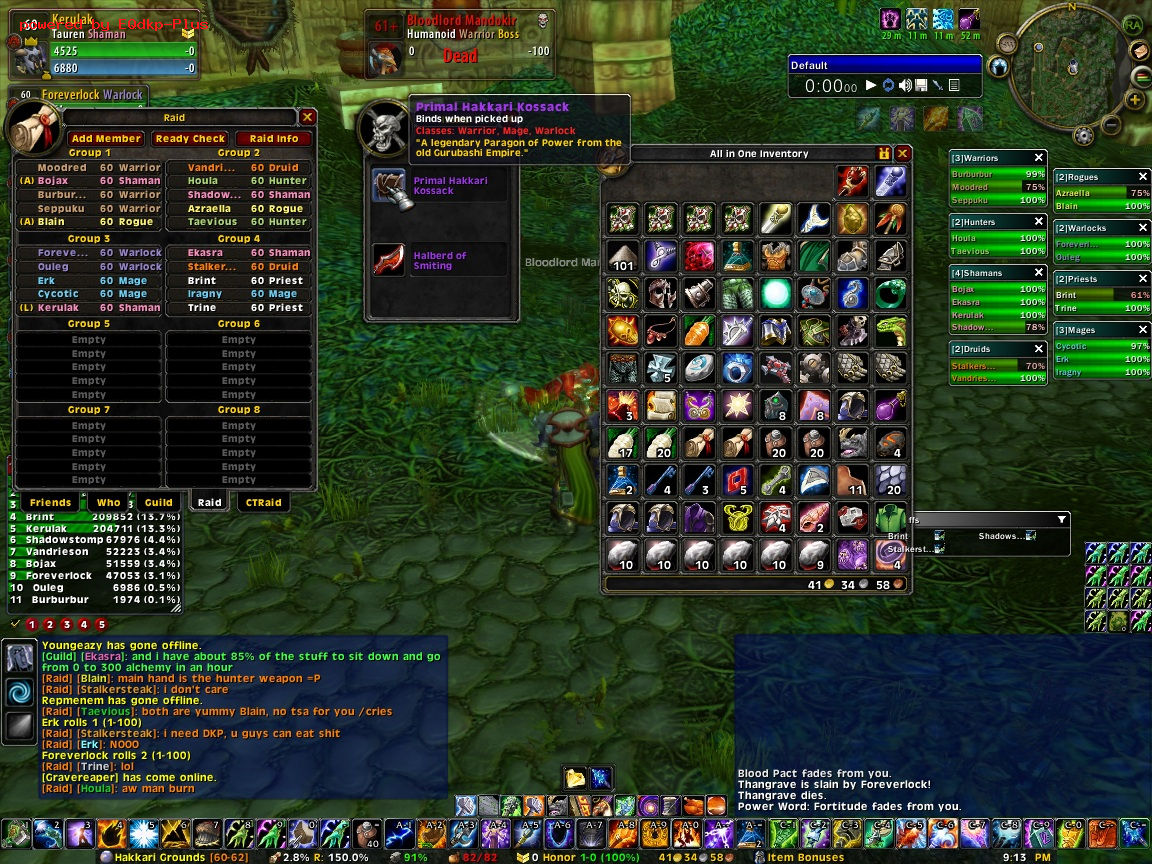
Kerulak adjusts his UI, working
RDX into his list of add-ons,
Zul'Gurub

RDX

When I got back from my summer vacation, Ater had another efficiency waiting for me.

"I'd like the raid to try this mod out. It's insane."

Up until this point, we'd been using a multitude of mods: CT_Raid, Decursive, Recount...to name a few. And they worked reasonably well, augmenting our ability to change our healing targets quickly, cleanse players of debuffs, and see how far off our damage was. All of these mods were freely available to download from a variety of websites, and it was a well-known fact that world-first guilds were using some pretty customized UIs, so I made it a habit of keeping up on add-ons. But I had never heard of RDX before, and Ater made it clear why that was: it was the only mod that required a subscription fee. The developers had put so much time and energy into it, they expected some monetary compensation for their effort.

"You have to pay for the add-on? Wow. It must be pretty damn awesome."

"Oh, you have no idea, check out what it can do. It's bizarre..."

Ater gave me a demonstration. Immediately, I noticed that the healing frames would allow me to see incoming heals on targets. With this information available to me, we could gain an entirely greater level of healing efficiency and mana-conservation. I could also left and right click the frames to instantly decurse my target, obsoleting both CT_Raid and Decursive in a single blow.

"Check this out", Ater said, prompting me to open up a window that displayed a diagram of a room with geometric shapes representing various objects. Without touching a single key, the screen began to draw lines and diagrams by itself -- a ghostly pen laying an entire set of movement strategies out for me while I watched.

"You're drawing this!" I said.

"Yup, you can lay the entire thing out for players. No more confusion. They see exactly what you are talking about. But that isn't the best part, look at this..."

Another window popped up, "Downloading 56b of 4k..." It looked like a typical download progress bar. The numbers spun up to 4k as the bar filled with a new color, then disappeared.

"What was that?"

"I just sent you a new mod...in game. No need to go out and install anything."

Jesus, I thought. This mod was insane!

"So, we're going to have everyone run this now?"

"Everyone that needs it," he replied.

"But what about the cost? Some people will probably get upset if we ask them to pay for it."

"Don't worry about that, I've spoken to the guys that make it. The licenses are good."

It was settled, then. The A-team raiders would load up RDX, and we'd need all the help we could get...

...it was Huhu time.


Thursday, April 26, 2012

1.7. Tricks of our Trade

Kerulak gazes up at Ragnaros during
40-Man Raid work in Molten Core.

Fine Tuning

Raiding in Vanilla was unlike anything I had participated in throughout my gaming career. Just getting over the initial hump of requiring 40 players to be online at once, and coordinating their efforts in real-time struck me as somewhat of a miracle. Only once fireballs were flying across the giant dungeons, felling great behemoths left and right, did we begin to realize that we would need to proactively find ways to improve, even if it meant a tiny little little bit each week. These marginal improvements that we'd apply from week-to-week would infamously come to be known as baby steps, which was our only real weapon against the competition: other raiding guilds vying for bragging rights and new raiding recruits -- some of whom could easily come from our own roster. It was my job as Guild Leader to provide a raiding environment that was both fun and successful. Other guilds were doing the same thing, so I had to find a way to do it better.

In order to stand out amongst a sea of raiding guilds, Descendants of Draenor needed to collectively assess class role, ensuring that we would approach our raids with the highest level of professionalism possible. Other raiding guilds were failing by being extremely wasteful; they would send players into raids without knowing who should play which role, instead just playing “however they wanted”. By looking at some of the world's best raiding guilds (at the time) we discovered a fact early on. Each class in WoW had a specific role in raids, and in order to be effective, deviation from those predetermined roles wasn't an option. In many cases the choice was obvious: A Rogue, for example, is a class that leaps out from the shadows and quickly ends his foe's life with razor-sharp daggers or swords. In a raid, rogues play only one role: Melee DPS (Damage Per Second). Rogues fall into a "pure" category class, alongside Mages, Warlocks, and Hunters. They do one thing: kill bosses in the face until dead.

The remainder of classes in WoW, however, can play multiple roles. This is based on how they have their talent points applied (what we refer to as their Talent Specialization or "Spec"). A Shaman, for example, could be specced to hurl lightning bolts from a distance, making them a Ranged DPS class. Or, they could be specced to utilize two one-handed weapons up close, swinging them at their target with the fury of the winds, standing side-by-side with a Rogue. This style plants them firmly in the Melee DPS department. Alternately, they could spec a third way, remaining at the back of the raid, blanketing their friendly party members with a protective layer of spells which replenishes health and grants shields. This style of play falls into the Healing category. We refer to classes that can play multiple roles based on their talent specialization as "hybrids". During Vanilla, the hybrids of WoW were the Shamans (if Horde), Paladins (if Alliance), Druids, Warriors, and Priests.

Just Because You Can...

While multiple roles were available to the Shaman in a raiding situation, there was truly only one spec that was viable due to the way Blizzard had balanced each of the nine classes. The cards of fate revealed to me that Shamans were to play the role of a healer, nothing more. The raiders in Descendants of Draenor quickly assessed what their role was, and embraced it, and if they didn't, they would be replaced by players that did. To lead by example, I was the first Shaman to lay down my weapons, and take on the responsibilities of a healer. I began to spread this belief system across the raiders of Descendants of Draenor, so that they, too, would embrace their class's fated role. Many did without hesitation. Some, however, remained in denial. They had originally chosen their class because of the emotion it instilled in them when they saw the class tearing monsters apart upon the lands of Azeroth. Choosing a Druid, for example, may have spoken to certain players because of their ability to shapeshift, taking on the form of a Bear that was virtually un-killable, or perhaps to a Cat, entering stealth (like a Rogue) and sneaking up on a foe, tearing them limb-from-limb. 

Being told that in order to perform at your maximum capacity, you were to stay in the back of the raid and cast healing spells on your party, came as an awful blow to some. Once provided with this revelation, many threw up their arms in disgust and walked away from raiding. Others bit their tongue and played their fated role as was expected of them...but they did not enjoy it nor embrace it. This produced a large subset of players that were often performing at 50% or 75% of their maximum efficiency, and was a sad result of Blizzard's design we had no control over. Flexibility in class role would not come until much later.

There were ten bosses in Molten Core. With our raiders now playing the role cards they had been dealt, if we were diligent, we could get the first three bosses done in two hours. I thought our speed was reasonable, but at the amount of bosses in Molten Core, the reality of making an entire clear in one evening seemed unfathomable. We only had a few hours each week to make our attempts, and because we employed such a wide variety of players across North America, managing multiple time-zones and keeping players focused and awake left us a small window of time to execute content. There had to be a way to increase our speed.

As Kerulak finalizes raid invites,
Haribo announces healing assignments.

The Moment of Clarity

One night, I stumbled across a video uploaded by a European WoW guild called The Axemen, who performed a full clear of Molten Core in 1 hour and 30 minutes. After watching the video with mouth agape, I had a moment of clarity. Immediately, I sent it to my Warrior raid-leader, Ater, telling him we needed to crank our clear times up. He pulled the video apart piece-by-piece and began discussing it with the other Class Officers. The Axemen employed a strategy known as "Chain-Pulling": the raid is in a constant state of pulling trash and killing it...as trash is about to die, tanks are already moving into position to pull the next pack. We began to train our raiders to expect this kind of chain-pulling so that they were not surprised when there was little time to break, sit, drink...breathe. We pulled monsters non-stop.

In order to facilitate this chain-pulling, our healers (having a finite amount of mana) had to come up with new ways of maximizing their endurance. Previously, they could sit down and drink after each pack of trash or boss was killed. Our new chain-pulling methodology removed this as a viable option. As we pulled trash faster and faster, our healers slowly expunged their mana pools until wrung dry like a sponge. This reduction in raid healing cascaded into player deaths, which only served to slow us down further. My Priest officer, Haribo (named after the candy company) came up with the concept of "Healing Buddies" to remedy this situation. 

Haribo's idea was simple, yet elegant. Every healer would be paired with another healer. As we began to clear trash on our way to each boss in the instance, one "buddy" from each pair would perform heals on the tanks and raid, while the other just followed along, doing nothing. Then, as each of the first "buddies" began to run low on mana, Haribo would spam out a “SWITCH!” macro in a channel he created (unsurprisingly named "dodhealers"). This would alert the healers to swap to the other buddy in each pair. Now, the new buddy would assume the role of healing the raid, while the first buddy followed along, slowly regaining mana. This saved us from having to constantly stop at various times between trash pulls while the healers drank and regained their precious mana. With Chain Pulling and Healing Buddies in full effect, we were able to increase our boss kill count from three to five in the first two hourskilling Lucifron, Magmadar, Gehennas, Garr and Baron Geddon. If it were a particularly exceptional night, we could even fold Shazzrah, a sixth boss, into that two-hour block.

Raids were moving noticeably faster. As with anything you do in life, the faster you go, the greater the chance of making a mistake. Some players simply did not adapt as quickly as we had hoped; either they had computer performance issues that held them back, or they simply lacked the reflexes to respond at a moment's notice to an emergency situation. Players would randomly find themselves face down in the dirt, killed because of a simple mistake. No amount of "better play from other raiders" could help offset this. We needed a contingency plan. Additional research revealed many hardcore raiding guilds were utilizing "out-of-combat battle resurrection". This surreptitious strategy called for certain players to keep a healthy distance behind the core raiders doing the work on the boss. By remaining far away from the action, they would kept themselves out-of-combat, which granted them access to spells normally disabled during the raid. One such spell was resurrection: the ability to bring a dead player back to life. Resurrect spells were disabled in-combat to add a degree of ownership to the raid; simply rezzing the dead over and over throughout the course of the fight meant instantly trivializing encounters, allowing players to sloppily die in fire with no repercussions. Theoretically, it was a valid guard-rail to empower players to be accountable as a team. In practice, unsolvable latency-related issues leading to lag-driven death were not considered for. Out-of-combat battle rezzes were a reasonable-if-slightly-unethetical way to combat infrastructure mechanics for which Blizzard provided no legitimate solution to.

Descendants of Draenor clear their first raid
 in its entirety: Molten Core

Bearing Fruit

Employing a delicate mix of improvements, either self-created or shamelessly stolen from other successful guilds, resulted in a dramatic increase in our efficiency. We were able to defeat Onyxia (our first official Internet Dragon!) on November 21st, 2005, and were soon farming her regularly for better weapons and armor. Meanwhile, we continued to clear content in Molten Core, faster and faster each week, pushing deeper into the instance, collecting up the materials necessary to craft fire resistance gear; equipment vitally necessary to withstand the fiery wrath of Ragnaros. Then, on the fateful evening of February 10th, 2006, Descendants of Draenor returned to Molten Core, stood before the mighty Elemental Lord of Fire, and delivered a final, fatal blow, sending him back into the depths of Blackrock Mountain. I almost went deaf with the victorious screams and cries of forty players calling out in digital unison, piped into my headset via our Ventrilo server.

We now not only had a structure in place to facilitate an efficient raiding system, we had proof that it worked: an entire 40-Man raid instance was cleared. We were filled with excitement and pride, and as we strode through Orgrimmar, displaying our weapons and armor from the instance, we began to turn more heads and garner additional interest in our guild. This came at a pivotal time, as we would soon discover (as other raiding guilds had), the difficulty of Molten Core and the next instance, Blackwing Lair, were as different as night and day.

We were about to get a wake-up call. One that would require that addition of a single Rogue that would forever change the course of history in Descendants of Draenor.

Thursday, April 19, 2012

1.6. Asymmetric Insight

2nd-in-command of DoD, Graulm, shot next to
DoD's Warlock Officer, Gutrippa

Emotionally Intelligent

As the new year of 2006 rung in, I was at last enjoying the benefit of a fruitful, prosperous guild. The many late nights I'd poured into negotiating guild merges, strategizing takeovers, poaching skillful raiders that were unhappy in their current situations...had all paid off. The result was a 40-Man raiding machine, now making weekly clears of Molten Core, diligently scooping up loot, and acquiring the necessary materials to craft fire resistance gear; items that would be vitally important to the defeat of Ragnaros, one of the four Elemental Lords in the WoWniverse. Structurally, we were rock solid. Per Graulm's suggestions, I had appointed one officer for each of the classes, and this delegation of authority allowed us to ease the administrative nightmare surrounding 40-Man logistics. The officers were sharp, each was an expert in their respective field, and I perceived them to be equals, all contributing to one another as they guided the raid teams down the serpentine caverns of brimstone that lay hidden beneath Blackrock Mountain.

My officers were extremely competent in their respective class departments; part of what made them effective was their ability to understand and convey complex raid mechanics to the team. A simple example of this was the decision behind forcing our melee DPS to attack mobs from behind. Any player worth their salt will tell you why this is so: attacks from behind can't be parried, which improves the player's DPS. Less parrying equals more strikes on the target, and more strikes, therefore, means more damage. However, there was a far more subtle mechanic at work, and when less-than-stellar players tried to defend their incompetence and laziness, my officers would step up and bring out the big guns: Attacks that were parried by a boss caused the boss's swing timer to reset, producing the effect of another instantaneous attack. This "parry-hasted" swing, coupled with a random mechanic in Vanilla raids known as a "Crushing Blow" -- a strike at 150% damage of the normal attack -- could potentially take a tank out in a single shot. It was about more than just improving damage, it was also about implicitly increasing the survival of the tank. Luckily, I had Ater leading the troops into battle, and thanks to his qualities in directing raid-related traffic, the raiders of Descendants of Draenor knew and understood the value of the individual contributing to the greater good.

This WoW-related expertise lay completely at the mechanical level. As players often joke, much of it isn't "rocket surgery". Where things become truly complex and difficult to understand are when one must make an evaluation of a person. It's easy to see why one person's damage is in the toilet, and remedy the situation with a new set of gear or spell rotations; it's an entirely different can of worms to try to predict why people behave the way they do, what their intentions are, and what their hidden agenda is. Some leaders, as it turns out, have an innate ability to read people; their emotional quotient is high and attuned to the nuances of behavior. Others mistake their "reads" of people, unaware of their own cognitive biases. This leads them to falsely blame one set of behaviors as the cause, when an entirely different set of variables are at play.

And this is where Ater the Idealist and Graulm the Realist began to bonk heads.

Khaevil makes a sarcastic comment
about what girls want in WoW

'Til Death Do Us Part

Xorena the Priest and Khaevil the Mage were a husband and wife team recruited into the guild in late October of 2005. A seemingly pleasant couple, their intention was to join the 40-Man raid team and offer their services in our quest to clear content. They were extremely well played; Xorena healed like a champ as mists of holy energy washed across the raid from her lightning-like reflexes, and Khaevil produced stupidly high damage as he let fire fly from his fingertips. They joined our 40-Man roster and continued to strengthen our raiding backbone. Additionally, they loved to PvP together, and found themselves in battlegrounds alongside other DoD veterans who enjoying seeing the Alliance scream and writhe in agony. Haribo and Annihilation, my Priest Officer and Warrior Officer, respectively, often entered Alterac Valley and Arathi Basin with Xorena and Khaevil at their side. To all, it would seem, Xorena and Khaevil were team players and soon to be considered a part of the DoD family.

All, except Graulm.

Graulm expressed concerns to me early on regarding Xorena and Khaevil. Their intentions were not with 40-Man raid team, or with progression at all. He had already sized them up, and confirmed his beliefs with another Officer, Annihilation -- another guildy who possessed the innate ability to read people. And to them, Xorena and Khaveil read like a children's book. The husband / wife team cared little for 40-Man raid progression, and were only there to collect loot for their personal benefit in PvP. As soon as they acquired what they wanted, I could expect to see their priorities shift...and not in favor of the raid team. My default modus operandi was to try to see the good side of the situation, to artificially inflate the pros over the cons, but Graulm stayed firm: it was a mistake to move forward with them, and I needed to cut them loose.

Severing them from the raiding artery was a huge risk, it meant the possibility of the the raid team bleeding out. I raised this concern with Ater. His assessment was much more idealistic than Graulm's; he saw the "good" in people, and was loathe to make judgments on observations of behavior -- especially ones in a game which cloaked us all as good guys or bad guys. He had a very supportive mindset and was sympathetic towards all players, giving them a chance in Molten Core that most raid leaders would shy away from. Even though it went against my gut, I leaned towards Ater on this decision, and allowed Xorena and Khaevil to stay. I believed them to be valuable contributors, and that minor PvP-related preferences would not get in the way.

Kerulak mediates loot drama with Khaevil while the raid
continues to clear trash in Molten Core

Double Standards

The husband, Khaevil, was an excellent, professionally-played character, and one of the top damage dealers in our raid. Unfortunately, he was absolutely awful as a human being. He was extraordinarily disrespectful and rude to both players in my guild, and players in other guilds. This, of course, upset me greatly. Descendants of Draenor was founded on being different in that we weren't going to be a bunch of foul-mouthed shit-talkers like every other guild on the server. We were going to make an concerted effort to be a little bit better. Yet, Khaevil's treatment of players went against everything I wanted the guild to stand for. And I sat by, letting the behavior continue, lying to myself and convincing myself "it wasn't that bad" and that if people built up a thick-enough skin, we'd be able to carry on. If I ever doubted my decision, I fell back to Ater, who showed me the light, and confirmed my bias. Thus, Khaevil and Xorena continued on in DoD, creating an unhealthy double standard that others would soon take notice of.

Graulm grew increasingly frustrated, eventually to the point of breaking. He'd had enough of Khaevil's disrespectful attitude, and was tired of me ignoring him, instead favoring this "new, fantastic Warrior" as my go-to person to solve all the guild's problems. I can imagine he also grew disgusted with my disregard for upholding the guild's ideals at the risk of sacrificing raid progression. As the weeks turned to months, he withdrew increasingly from the officer spotlight. He contributed less to guild management, which I can only assume was due to the fact that he felt whatever he would bring to the table, I would simply snuff out by contrasting with Ater's stance. Eventually, his position as 2nd-in-command of DoD became nothing more than a title in the guild roster, and by the fall of '06, he packed up his stuff, and walked away. It was a huge hole to fill, both in officership and in 40-Man progression. 

The party did not end there.

Graulm pictured at the base of Blackrock Mountain
in full Tier 2 (Felheart) Warlock gear.

Cleaning up the Mess

Five months after Graulm left Descendants of Draenor, I took Xorena into our Ventrilo server one evening and gave her and Khaevil their walking papers. I’ll never forget how horribly upset she was; devastated is probably a good way to describe it. She was emotionally distraught, crying in Vent, trying to find a way to negotiate the situation, to see if there was any other recourse. There wasn't. They had to leave. The ejection left me physically exhausted; I wasn't prepared for her response. It was tough to take. The best part? Not only had I lost a core Priest and Mage out of 40-Man progression, I had sacrificed my 2nd-in-command in the process. I hadn't listened to him; I hadn't taken his concerns seriously enough. It was important to stay true to who we were as a guild, and that was more important than a boss kill. I couldn't make "allowances" for players, based solely on their damage meters; it was a double standard that would eat away at the core of the guild. And by ignoring the problem, I simply made the situation worse -- instead of losing two players (which I would have lost either way), I also lost the person that started to teach me the basics of leadership. I avoided the situation because I thought it would go away; that maybe perhaps some other officer would eject them on my behalf. I learned fast that nobody wants to do that. Nobody wants to be the enforcer of the rules, the bearer of bad news. Nobody wants to hear a gal plead with you in Vent while choking down tears that there must be another way to solve this issue. 

People avoid conflict for a reason.

And so, with the guild down an officer and two core raiders, I learned my lesson about double standards and vowed not to let it happen again. I discovered in practice that it was one of the hardest rules to enforce in the context of WoW. We would ultimately go on to gain a multitude of expertly played individuals over the course of many years of raiding, and some of them had horrible personalities. It took every ounce of energy to keep the roster filled with players able to rotate into spots that were left by players we ejected due to shitty behavior; it simply wasn't realistic, to be honest -- it became a full-time job. And it weighed heavily on my mind those months we worked on Molten Core and Blackwing Lair. I didn't give up. I was determined to see us succeed, at whatever the cost. My hope was that I would be able to continue to turn to Ater for advice, while tempering it with what Graulm had taught me.

Yet, the unanswered questions kept me up at night. Why did Ater put good faith into people that so obviously backfired? Was Graulm right about his assessment, or was there a far more complex set of circumstances working toward the Husband/Wife team being forced out? As my time with Ater continued on, he would prove to me he had far greater insight into people than I.

And thus, my training began.

Thursday, April 12, 2012

1.5. The Idealist and the Realist

Kerulak holds his healing position during an Onyxia (40-Man) attempt.

Leadership Emerges

After only a few weeks of absorbing The Final Cut, we had become a fully-staffed 40-Man Raiding guild, and were executing bosses with extreme prejudice. We had a lot of ground to cover; Vanilla had already been out for nearly a year, and Blizzard was hard at work in preparation for the next tier of raid content, The Temple of Ahn’Qiraj. For us, it seemed a lifetime away, since two raids and 18 bosses stood between us and that next tier. Luckily, our roster had finally reached full capacity; a talented, eager set of players that were determined to raid. It was during this next year that we experienced a multitude of wins and losses, of tragedies and victories, and ultimately gave me my first real lesson in what it took to maintain a successful raiding guild: beware the double-standard.

I remember flying out to California in late October ‘05 to attend the first BlizzCon, and while I took the stage in the voice competition, busting out an impression of Deckard Cain from the Diablo series, the Descendants of Draenor raid team was back home, executing boss kills in Molten Core, earning us both credibility and gear. We also broke ground in a separate one-boss raid, Onyxia’s Lair, and began working on killing our first dragon, a raid that would ultimately take weeks and weeks of practice. I met a few of my guildies in-person at BlizzCon that October, and it was a cool feeling to be able to finally put a real-life face to an in-game character. WoW was, after all, a social experience. If I was going to keep Descendants of Draenor on the winning path, I would not only have to embrace my character’s role and responsibility in raids, I was going to have to learn more about the people behind the characters. Then, I could be certain they would work well together as a team.

During the next several months of raiding Molten Core, I noted that there were a few personalities we gained from The Final Cut that had tremendous leadership potential. One Warrior in particular had an extremely commanding presence about him. His name was Ater. He had offered to pick up the leadership reigns of Molten Core, having driven his own 20-Man Zul’Gurub raids throughout the week. Like clockwork, every three days (the reset timer for old 20-Man raids) he would rally the troops, taking the very best of the guild, and plow through the instance, with his sights set on killing Hakkar. Few guilds at that time had a Hakkar kill under their belt, and Ater felt that it was a reasonable accomplishment to work towards. It wasn't that the raid was necessarily difficult, but 20-Man Zul'Gurub fell into an awkward category in those days.

Kerulak snaps a picture next to Ater within Molten Core

Rewards Match Effort

Guilds of 40-Man raiding size were focused on much more challenging 40-Man content. To them, a raid that was half the size also meant half the challenge -- and rightly so. Those 40-Man raiding guilds that chose to tackle Zul'Gurub "as a goof" ended up wrecking the place. Gurgthock and his Elitist Jerks artificially increased the challenge by leaving nearly all the priests alive while killing Hakkar, causing the Blood God to gain a series of buffs making him nearly invincible. Without inflating Hakkar's difficulty, it wasn't worth their time. Zul'Gurub's rewards matched its effort, and in those days, the piddly blue items couldn't hold a candle to the gear that dropped out of a 40-Man raid. 

And yet, guilds that didn't boast our size or dedication to raiding simply could not put a random group of players together to do Zul'Gurub. Short of the first two bosses, High Priestess Jeklik and High Priest Venoxis, Zul'Gurub's 20-Man breadth remained out-of-reach for most casual players; any player even able to catch a glimpse of High Priestess Marli or beyond was considered a sharpshooter.  As a result, Zul'Gurub often went unfinished on servers. Vanilla's meta-game of gearing for raids was paradoxical in retrospect: To make any kind of raid progress, one required raid gear, but the gear wasn't available unless you raided. This design acted as an artificial gate to prevent casuals who had no business setting foot in a raid from even bothering. The flip side, however, was that getting your foot in the door meant exploring every option, finding any hidden tip, tactic, secret, strategy, or obscure loot that would augment your play just enough to keep it together for that first boss kill -- ones that ended with nearly the entire raid face down in the dirt. This artificial gating design of Vanilla WoW drove some players to push themselves to the absolute limit.

Ater was one of those players.

Ater was determined to execute Zul'Gurub in its entirety, since it was the only reasonable content he had a shot at completing during his membership in The Final Cut. He didn't care about the gear, regardless of its inferiority to Molten Core, he cared about the accomplishment. I heard it in his voice over our guild Ventrilo many nights -- that passion and hunger to complete content, just like any dedicated gamer who's focused on beating a game. His passion for gaming, and demonstrated leadership via Zul'Gurub, led me to hand him the wheel in our 40-Man raids as well, and it wasn't long before I promoted him to an officer rank, sitting alongside my existing DoD officers. But with his promotion also came dissent. Ater, while liked by many in my guild, held philosophies that clashed with others I put in a role of responsibility. Unfortunately, I had to bear the brunt of that fallout on my shoulders alone. 

Hanzo's alt, Oxanna the Tauren Druid, acts as
Guild Bank during Vanilla

The Basic Building Blocks

My 2nd-in-command was a Warlock named Graulm who had brought his EverQuest guild experience to the table, helping me lay the foundations for all the basics a guild would need. I originally met him in Stranglethorn Vale, while playing my Mage, Elephantine. We struck up a conversation, helped each other with a few quests, and continued to chat and assist each other over the next few weeks. During my assimilation phase, I stalked and harassed him to throw in the towel with his existing guild, and tried to make him see "the one true way". He fought me at first, but I eventually managed to sway his opinion. Once on board, it became clear his EverQuest guild-management experience would play a vital role in my learning process. While other guild members were focused on questing and clearing 10-Man Stratholme, Graulm was busy laying a foundation for Descendants of Draenor. The guild lacked structure, and leadership was essentially only an extension of the /ginvite command. He aimed to resolve that.

One of the first orders of business was a guild bank, which Graulm directed me to set up early on. Back in Vanilla, it was comprised solely of a series of alts holding items in bag space, since WoW wouldn't actually introduce true guild vaults until the first expansion. My alts, therefore, were used to store guild- and raid-related items, ferrying things like Gurubashi Coins around to players as needed. Graulm pointed out that there was more to this than purely convenience; it ensured that the management retained leverage over the guildies. He reasoned that it would keep them in line, so they would remember who was in charge; storming out of the guild in a tantrum of drama would mean walking away from earnings they themselves contributed to. An implicit psychological attachment to raid tokens would keep people loyal. Ownership, as it turned out, was a powerful motivational tool.

Graulm also identified a key flaw in my guild's forums that he felt needed to be addressed: we lacked an officer-only section of the forums. Managers needed to be able to go behind closed doors, and discreetly discuss the management of the guild. Often, this meant engaging in conversations about how to handle certain individuals. It wasn't appropriate to speak in public about the disciplinary actions surrounding a particular player in the guild. Graulm showed me that, like a business, the guild had a responsibility to conduct itself in a professional manner. Being respectful toward one another goes both ways, he reasoned, and if I was compelling the guild to follow my moral compass of treating each other with dignity, it had to start with leadership setting the example. I remember vividly the day I locked the non-officers out of a section of the forums; panic ensued. What was I hiding from them? What were we planning on doing that they weren't allowed to know? Graulm eased my anxiety. This response was expected, and was par for the course.

These basic building blocks of a guild structure may seem like common sense to seasoned guild leaders, but back then, I was but a babe in the woods. Thankfully, I was able to get Guild Leadership 101 from Graulm, and provide enough structure to conduct ourselves in a semi-coherent fashion. Up until that point, Graulm had been acting as the little man behind the curtain to which no one paid attention, but he himself knew intimately the role he played, and his value directing traffic on my behalf. And there was no one to question his authority by proxy, since he alone pulled the strings; I simply danced on his behalf.

So, you can imagine what happened when another influential leader entered the stage, one with a difference in opinion of people than what Graulm held. The effect was not unlike trying to push two magnets together. The positives didn't want to play nice, and neither did the negatives.

Thursday, April 5, 2012

1.4. Two Suns in the Sunset

Kerulak and crew make their way through Zul'Gurub (20-Man)

Outlook: Hazy

In the meta game to build up my ranks to 40-man raid size, I was beaten black and blue. Guild leaders were hard to read and size up, especially without seeing them face-to-face. There were no hints, clues, body language to pick up on. Were they bluffing or giving me the straight story? Could I trust them or would they eat my guild up from the inside out, turning my players against me? Were they as skilled as they claimed to be, or were they “face-rollers” -- players who seemed so completely inept and incapable of stringing together a series of abilities that it seemed as if they were literally rolling their faces across the keyboard, randomly pressing a multitude of buttons in the process. The art of negotiation took extreme finesse, I had to listen carefully to what opposing guild leaders meant, which wasn't always the same as what they said. My experience with Juxta proved this: When he said one thing, Atrocity did another. Their raid coordination was non-existent, as was their leadership. I learned an awful lesson about blindly trusting players on the server, in the name of building a raid team, and Descendants of Draenor had a chunk of flesh missing as a result.

I continued on, seeking new faces for our roster, but it was no less difficult to acquire them. Sometimes I thought I had a guild merge wrapped up, only to find out hours later that they had completely changed their mind and gone a different direction, merging instead with a competing guild. It was stressful and exhausting, and required me being online every night, late into each evening. I'd open up new communications with other guilds, survey the landscape of the server, reach out to new players, and try to spread the word that we were the place to be for 40-Man raiding.

This, of course, was a blatant lie. We'd had about as much raid experience as Fred Savage had playing Super Mario 3 at the end of The Wizard: not a whole hell of a lot.

So, the marketing spin continued. Desperately, I lobbied for Descendants of Draenor, in the hopes someone would bite. Meanwhile, I filled the gaps by piecing together a few Molten Core attempts with whom we had left in the roster, though it was never a complete 40-Man group, and although we managed to make our way past the two Molten Giants at the door, we typically didn't make it much further before people had to start logging off for the night.

How in the hell was I going to keep 40 competent players online, on a regular schedule?

I prayed that I would get another opportunity to make a guild merge happen. If it did, I reasoned, it would be the last opportunity I'd get to make it right; if I botched another merge, all would be over for Descendants of Draenor, and any hope of us ever tackling 40-Man raid content would be swept away into the virtual ocean of WoW guilds on Deathwing-US.

I got my wish.


Kerulak, accompanied by newly acquired
members of The Final Cut, lay waste to Zul'Gurub (20)

The Final Cut


A few weeks after the Ugly Black Warhorses incident, I received an email from a player named Darange who said he wanted to have his guild and officers have a chat with our officers about a possible guild merge. They were members of a guild called “The Final Cut”, and I had no knowledge of them or their exploits on the server. I arranged a meeting between both sets of officers, and we would hold an online chat to discuss any questions they might have for us. Going into that chat, I was a wreck. My guild’s roster was slipping away, and the previous few guild merge attempts all ended in stalemates. This one was going to either make or break us, I thought. I wanted to bring ammunition to that meeting, something that could definitively put us ahead of other competing guilds, but kept coming up snake eyes. We had no proven raid experience. I needed something for us to latch on to, to make us appeal to the members of The Final Cut...I just didn't know what.

We met with them and chatted. Introductions were traded, and we talked about our experience with the game, and where we wanted to go. I was struck by how very well organized they were; they came across as very professional. There was no shit talking, no typical “dude” or “bro” or any of that--the conversation was professional and mature. In fact, as the conversation continued, I couldn't get past the feeling that I was being interviewed for a job. And it was at that precise moment that the light went on upstairs:

Hardcore players take raiding seriously. It needs to be approached with a level of professionalism that casuals simply do not possess. If we want to sell ourselves as a successful raiding guild, without having any actual raid boss kills under our belt, we are going to have to demonstrate this level of professionalism.

I immediately steered the conversation towards the work we had put into the planning stages of our raids. I spoke of our DKP system, and how loot issuing would be enforced. I discussed with them the role of the various officers in the raids (before the officers even knew what I was talking about). And when the other guild asked about our existing efforts in Molten Core, I was sure to communicate that, while we hadn't seen wildly amazing success, we had definitely seen progress, and had a system we would follow, refining until bosses fell over dead.

It seemed a bit bizarre to speak about a video game in much the same way I’d describe performing management-related tasks in my career, but everything about successful raiding guilds spoke to that extreme level of dedication and focus. I must have said the right things, because a few days later, I was mass inviting the members of The Final Cut into Descendants of Draenor. It was the last significant assimilation we needed to push us over the edge into 40-Man raid territory. We began testing the waters with this new set of recruits, dipping our toes into the then-new 20-Man instance Zul’Gurub. Initial reports were fantastic. The new recruits gelled so well with our existing roster, that we made huge improvements in our ability to execute content. Prior to the assimilation of The Final Cut, we hadn't even managed to get much further past the first boss (High Priestess Jeklik)...and were now consistently killing Marli, Venoxis, Thekal and Arlokk, with Hakkar (the final boss) in our sights. The dedication and focus to raiding was paying off.

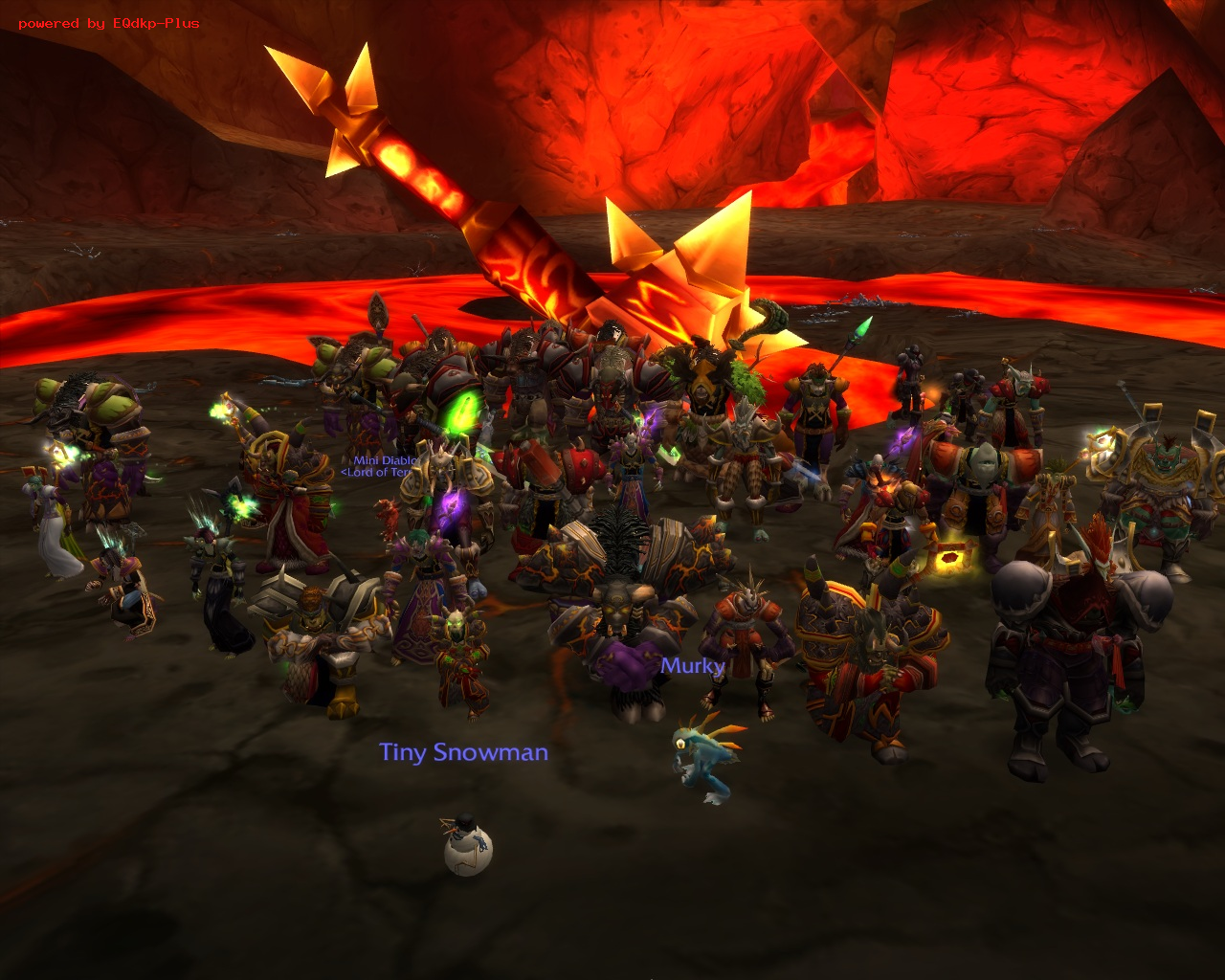
Descendants of Draenor defeat their first boss,
Lucifron, as a complete 40-Man raid team.

Molten Core

One night, while questing around Stranglethorn Vale, my Shaman officer Kadrok sent me a tell:

“Uh, you know we have 40 people online right now?”

I popped open the guild tab, and sure enough, there they all were.

“Wow. We do have 40 people online. We could totally do Molten Core right now.”

Not a second word was spoken. Immediately, the officers began rallying the troops, and players were suddenly being mass invited to a raid. Was this it? Were we about to become what I had set out to accomplish? Actually be the size enough to field a 40-Man raid and be successful at it? The raid roster filled up with 40 players, and we began our flight to The Burning Steppes, headed towards Blackrock Mountain, where the entrance to the Molten Core awaited. The raid chat lit up like a marquee as officers began organizing their groups of players, figuring out who had which position, who would perform what role. One by one, we arrived at the entrance, leaping over a brick ledge and falling into a sea of lava, only to be quickly teleported into the Molten Core. I’ll never forget zoning in with the guildies surrounding me, as we began to buff, get into position, and nervously make that first pull of the two Molten Giants towering above us at the Core’s entrance. I held my breath, and we pulled. The Warriors ran up, shields in hand and grabbed a hold of the gigantic stone creatures, arcane missiles flew, fireballs and shadow bolts cascaded across the cave entrance, lightning shot out of players’ hands, and our health spiked up and down frantically as the healers struggled to keep us all alive, while the Giants pounded our raid into the ground. We continued to volley attacks at the Giants, the tanks struggling to keep them in position, and eventually, the two gigantic creatures made of molten rock fell over dead with a huge crash. We surveyed the results...we weren’t dead! The two Molten Giants lay silent at our feet, and we had survived.

And just like that, we were a raiding guild. On October 12th, 2005, we executed our first 40-Man boss kill, Lucifron, catapulting us into the raiding spotlight in which there would be no turning back. And the speed bumps were only beginning..

Thursday, March 22, 2012

1.2. The Casual and the Hardcore

Kerulak assists in a 15-Man pickup
group or "pug" circa Vanilla,
Upper Blackrock Spire

Casual is Bliss

If you've never played World of Warcraft, there are a wide array of dungeons to explore. These dungeons very typically take 5 players, which consist of a tank (the person responsible for grabbing a hold of a pack of monsters and keeping their attacks focused on him), a healer (a person responsible for keeping the tank from dying), and three miscellaneous players which fall into the category we call “DPS”, which is WoW-speak for “Damage Per Second”. Those three remaining players focus all of their attacks on the monsters, and kill them as fast as they can, before the healer runs out of mana, which in turn, causes the tank to eventually run out of health and die, causing the monsters to turn their attention to the rest of the party, killing them off one by one. This chain of events ultimately leads the entire group of players falling over dead, and having to run back from a graveyard, this is the act of “wiping”.

For seasoned WoW players, this is common knowledge, but what may not be so obvious is that, back in Vanilla, there were a few endgame dungeons that required more than 5 players. Scholomance, for example (a dungeon dedicated to the schooling of dark wizards) wasn't a 5-Man dungeon, it was a 10-Man. And it was not something that was done quickly, it took hours to complete. It took patience and very slow, methodical execution; one wrong move would lead to a wipe, and it could be caused by something as simple as standing 2 ft. to the right of a pack of monsters (“trash” as we call them), rather than 2 ft. backward. Scholomance was an end-game dungeon, and it required everyone to be at the max level (60, at the time), and it was unforgiving to the general populace, because it demanded exquisite control and discipline of your character and the ability to work together.

However, most of the players in World of Warcraft didn't posses this sensibility, having grown accustomed to the lightweight dungeons they experienced during the 1-60 leveling grind. Today, a multitude of online resources exist, that have combed the depths of WoW and provided guides, tutorials, tips and tactics for players, but in Vanilla, these resources simply did not exist. As a result, the majority of the WoW player-base ultimately remained in a sort of “blissful ignorance”, unaware of the game’s depth and mechanics, and didn't have a clue that their skills could be refined, taking their play to an entirely new level. They were forever lost in the illusion of The Matrix, logging in, checking their auctions, cooking virtual food and mixing/matching sets of armor to tweak their character’s costume.

We called these players casuals.

Uld flirts with Maxxum of Dirty Work, Inc.

Eyes Wide Open

Several months into Vanilla, I struck up a friendship with a player named Maxxum. I had tried (unsuccessfully) to recruit him away from his guild on multiple occasions. He was always polite when he refused, but he would still strike up a chat with me whenever possible. One day he invited me to help fill the 10th spot in a Scholomance clear. I wasn't particularly looking forward to another 2 hour dungeon run, but to help break up the monotony, I said I’d come along. When we got into the dungeon, I was still getting adjusted and settling down in my chair, making sure all my macros were set up when the chaos erupted. Like some kind of bat shit crazy insane players, Maxxum and his guild began tearing Scholomance apart. They moved from pack to pack in a blur, having some kind of unspoken system; their efforts were completely synchronized and coordinated. A Rogue would sap one monster, stunning in position, a Priest would shackle another undead minion, locking it in place. All of the players then focused their attacks onto a single monster at once, the remaining targets left alone, incapacitated. With everyone beating on a single monster at once, it was annihilated.

Maxxum and his guild had a system, and it was like nothing I had experienced before. It was fast, efficient, disciplined. Each member of the team was mindful of every piece of info available to them; where they needed to stand -- the tank facing the mobs away from the party, while the melee DPS positioning themselves carefully behind each target, thereby reducing dodges and parries. The healer took a proactive approach to each pack, contributing to crowd-control, winding up large heals in preparation for big damage, then cancelling if the heal wasn't needed, thus conserving mana. When we walked out of there 45 minutes later, I was stunned. I'd never seen a group of players clear Scholomance in under 2 hours. There was a term that WoW players used to describe this level of dedication to the game, this expert-like knowledge of the game's mechanics, which led to a flawless execution of content.

We called these players hardcore.

Having experienced both ends of the spectrum, I knew that Descendants of Draenor would have to lean less into casual and more into hardcore, in order to truly stand out and provide a respectable, successful home for players on our server. I wanted to know what it would take to get my guild to this level. When questioned, Maxxum gave me two words as a response: Molten Core. I didn't know what it was, only a few people in my guild seemed to have a idea, it was something that was referred to as raid content. But it wasn't just like any dungeon we had explored before, it would require surgical coordination to execute correctly. And it would require a few more players than 10 to run...

...it would take 40 players.

I’ll never forget the last piece of advice Maxxum threw my way: “Watch out for that first pull. It's a doozy.” I started to do research. I snuck into a few Molten Core attempts that had been pieced together by random players in Orgrimmar, thinking they would have enough leadership and coordination to make a few pulls. Those attempts all failed miserably...at the first pull. I would watch as the two towering Molten Giants guarding the entrance would stomp forward, shaking the ground, and bashing the pathetic members of the raid into oblivion. Tanks would fall over dead in one hit, healers would be out of mana in seconds, and players ran around in a panic, trying desperately to get away from the Giants. And one by one, the raid was destroyed. It was embarrassing to see players this incoherent. There was no way I was going to let this content go unfinished. My guild had cleared everything in the game thus far, and it was time to make the leap...the leap to hardcore.

Kerulak surveying the guild roster as he
continues to assimilate guilds during Vanilla

Resistance is Futile

The plan to shift Descendants of Draenor into a new mentality of hardcore raiding seemed very daunting. I wasn't really very sure how we would pull it off, so I began simply in bite-sized chunks. The first order of business: mass guild assimilation. I hiked up my recruitment and began negotiating talks with other guilds on our server who were also interested in starting raids. Guild assimilation was very cut-throat. I was constantly competing with other guilds who were trying to do the very same thing: promise great rewards with absolutely no proof of experience. These competing “raiding” guilds hadn't set foot in Molten Core either.

Said they had. They. Had. Not. 

I had to find a way to make my guild stand out from all the others, even without a track record in the instance. So, I used what I knew we had under our belt as leverage. We were a solid team of passionate individuals, and we had explicitly laid out the most fair and just treatment to all our raiders. We even had a DKP system in place (rules describing how loot is issued out) before even setting foot in Molten Core, having researched this by reading blue posts on the Battle.net forums, taking their advice, ultimately leading us to other successful raiding guilds on other servers (notably, Elitist Jerks of Mal’Ganis-US). I had to make a lot of gut instinct decisions when deciding who to go forward with, and who to hold on, but I stuck to my guns on the most important fundamentals: I wanted players with honesty and integrity, who were respectful to each other, and who would demonstrate loyalty. And the one thing I would not back down on is: I would not give up our guild name. Our guild name would remain unchanged, and our core leadership would always be retained. Many other guilds decided to merge, form new names, and bring officers from both sides. They very rarely worked out; drama and power-struggles often caused these guild merges to end in collapse. We wouldn't follow suit. We would retain our identity. This was simply a non-negotiable for me.

Guild mergers, as I would discover, were not so easy to facilitate. Desperation would lead me to make a decision that would cause the first mass exodus of Descendants of Draenor, and almost cost me the guild in its entirety.