Showing posts with label cataclysm. Show all posts

Friday, January 2, 2015

4.21. Moebius

Mature tanks Foremaster Throngus while the
guild  completes its 15,000th daily quest,
Grim Batol
"There is the theory of the Moebius. A twist in the fabric of space where time becomes a loop."
                                                                        - Lt. Worf, Time Squared (S02E13)

History Repeats

Applications trickled in at the start of Cataclysm. I poked and prodded, harassing the guild to "sell, sell, sell" the DoD way of life to anyone who happened to show any interest...so long as it wasn't in /trade. Dredging the slimy reef of /trade for fresh blood only guaranteed that a good roster would quickly fall into disrepair. DoD's pitch spread by word of mouth, most often in LFD. There was definitely some interest in what we had to offer, but it wasn't as overwhelming as the nearly daily apps that filled my inbox during Wrath. Apps that did arrive were oddly familiar. I began seeing reflections of the past in my newest recruits, and caught myself comparing them to players from DoD's youth.

A husband / wife team, comprised of a resto druid and a shadow priest, were one of the first newcomers to DoD in Cataclysm. The druid, Beefsupryme, was droll and affable; his wife, Physica, was a smart match. As with all significant-other teams, I made it clear that pairing them could never be guaranteed, but I would do everything in my power to make it happen. They integrated into DoD's culture seamlessly, never once giving me push-back or cause for concern. The shadow priest even earned her own song: I'd swap her name into a horrific rendition of Olivia Newton John's 1981 hit, whenever we waited on her to accept an invite. Beefy and Physica very much reminded me of that first husband and wife team, long before DoD even began raiding: Hend and Chariot -- good people I lost over a difference in playtime preference.

Ignismortis was brought out way via Goldenrod; they were friends in real life. A fan of classical music, he came from the Malorne server, which he could not recommend under the warning of "low population, high idiocy." Ignis's warlock and Goldy's mage maintained a playful rivalry; the lock poked fun at the mage, soloing content and laying waste in battlegrounds. He wanted an opportunity to raid competitively three days a week or fewer, and Goldy was quick to point him to us. Ignis was charming, dedicated, and well-played; by recruiting him, I essentially gained a second Goldenrod. I was completely fine with that.

Insayno was a death knight who didn't fit the mold. He was gung-ho about PvP, but also about achievements...including those having nothing to do with bashing another player's face in. He filled up vent with "Awesome!" and "Dude!", yet could also channel those passionate outbursts into a fastidious dissection of the game's mechanics, breaking down the strengths and weaknesses of not only each class, but each spell. This was unbecoming of a death knight: they were long seen as the douchebags of the game. Insayno was the furthest from this stereotype. I was happy to have enthusiastic players in DoD, but as the 25-Man raid start date closed in, I contemplated what role he'd play, if any. At the very least, I had to give him props for the name; pop-culture references were my Achilles heel. Insayno very much reminded me of Annihilation, a DoDer often dismissed upon initial impression by way of crude language and a propensity to talk for hours about gaming -- yet hid vast knowledge of people once the onion was peeled back.

Littlebear, a hunter, joined up in the weeks leading to Cata's launch. His story was like so many that applied to DoD: he pushed past the boundaries of his former guilds, excelling where they fell short. In my interview with him, I couldn't help but be reminded of McFlurrie, back in The Burning Crusade. McFlurrie, like Littlebear, was one of the older players, but not entirely set in their ways. Both McFlurrie and Littlebear were open to innovation and new tactics. Neither balked at a lesson in their class, which nearly the entirety of the WoW community is known to not do well. Littlebear joined our crew, and immediately began consuming all of the necessary requirements to be vetted for the Raider rank.

Another Death Knight came to DoD, a tank by the name of Soot. Soot's interview was textbook. Well spoken, he had a deep, powerful voice that commanded attention over vent. Soot immediately struck me as the type of person to assume a role of leadership (as many tanks do). The interview went off the script multiple times, transforming into an open conversation touching on WoW, gaming in general, and even real life reveals. We shared a career path: he was a .NET Web App developer...

...Ater.

The initial Cataclysm recruits invoked quite a few memories of the past. But then again, I'm a bit of a sentimentalist.

Screenshot of the GCG addon interface
(Source: MMO-Champion)

Returning

The raid slot template bustled with the familiar. The officer core led the charge: Neps, Jungard, Blain and Sir Klocker, and my newest promotion to healing officer, Lexxii. Following closely were names committed to DoD finest from Wrath and earlier: warlocks Mangetsu and Vrykolakhas; hunters Larada and Jemb, the mage Goldenrod, the shamans Bheer, Gunsmokeco, and Deathonwings; paladins Drecca, Fred, and Falnerashe; rogues Bonechatters and Riskers, and the death knight Hellspectral.

Some familiar faces took new forms. After playing a warrior and druid, Omaric was now Zuzax, the Goblin shaman, changing his stripes once more. Moolickalot the druid was now focused on Cainh, a shadow priest. Lexxii's significant other, Bullshark felt the sting of the Hunter's lost mana pool (the Hunter resource became a Focus bar in Cataclysm) and shifted his attention to a mage named Bullsharq. Kizmet the druid was now Dkizmet the death knight. Even Bretthew returned to his old warrior Taba, formerly relegated to alt status at the end of Vanilla.

Rainaterror was a Troll shaman who joined us toward the end of Wrath. I first met her face-to-face at BlizzCon 2010, a friend of Bonechatters the rogue. My initial read of her left more questions than answers, but she seemed interested in participating in the 25-Man and, like her fellow guildies, began immediately to hit the necessary 25-Man raiding requirements. I wasn't convinced on her attitude, however. It seemed to carry a hint of indignance with it, a sort of "why do I have to do these things?"mentality that is so often a product of a player unfamiliar with raid demands and the frustrations of raid wipes. I pointed Rainaterror to the many posts we'd made on those subjects to answer her questions, but was left with the suspicion she didn't read them, and was merely complaining...to complain.

Immortalus the paladin, known by Sarge in Vent, also joined us during Wrath. He contributed to 25-Man progression with a youthful, perhaps slightly arrogant demeanor. I suspect it came more from the gamer mentality and less from an exaggerated perception of self-importance. Sarge was pro-DoD, which meant he was anti-everything else, and I was fine with that...especially if a few Alliance bit the dust in an unfortunate crossing of paths. His Alliance baggage kept him focused; formerly of The ORLY Factor, a known Alliance guild of dbags on Deathwing-US, he made every attempt to smoke his former partners in battle. But Sarge's biggest contribution to the 25-Man came in the form of GCG, short for Gentleman's Club Gambler, an add-on one of his former guild mates threw together to break the monotony of trash pulls and raid wipes.

GCG worked like this: an initial stake was placed, you voted in or out to participate, then everyone performed a /roll X, where X matched the stakes. The winner was the highest roll, and the loser (the lowest) paid the difference. High stakes meant lots of gold exchanging hands, peer pressure from the guild kept people participating, quitting cold turkey, then returning to lose once more again. The never ending cycle of gambling addiction could quickly become a distraction under the wrong conditions, but rather than ban it outright, I drafted GCGs' usage directly into our 25-Man raiding rules: only on trash pulls and during raid wipes. A possible detriment to the 25-Man’s focus quickly became a perk to raiding in DoD, and I have Sarge to thank.

Mature spots his guild's first 2nd-in-command, Graulm,
Orgrimmar

Leave the Past Behind

Operation "Water Under the Bridge" continued, opening the window of recruitment options further. Holding grudges got us nowhere; more important was bolstering the strength and confidence of the 25-Man roster. Putting drama behind us allowed me to extend an invite to faces I hadn't seen in years. My original number two, Graulm, made his way back into the game for a brief moment, and I was happy to have him rejoin, reminiscing about old times and pointing him to the new guild website. He clicked through the screenshot gallery, arriving at the pic of his warlock staring out into the Tanaris desert.

"I had no idea you felt I was this important to your guild."

"Well the secret is out," I told Graulm," you were one of the most important people to happen to DoD."

I'd already made amends with Falnerashe; she was now back in DoD and leveling alongside her bf Phil (he played many characters). Both held spots in DoD years earlier, and were quick to resume their old habits, shimmying up to their old crew, preferring to hang with the PvP crowd. I checked in with Fal at random to make sure things were going well. Whenever she opted to confide her frustrations with me, it was merited; Fal didn't just complain about anything and everything, she only got frustrated with idiocy. Sooner or later, we all end up in that unmentionable group of baddies; it's how we choose to react to that defines us. Anonymity can never be a justification for mistreatment. I compelled her to vent privately, and gladly received that barrage of frustration.

More big news for the changing roster was the return of Bulwinkul, another player that deserved a second chance. Axing him for mistreating Lexxii was extreme, but necessary. He repented, she accepted the apology, and we moved forward...but the re-invite came with strings. I warned Bulwinkul in the most straightforward language possible: Disrespecting other players maliciously will not end well for you the next time it happens. Of all the leashes on people in this guild, yours is the tightest. Bulwinkul agreed one hundred percent, wishing only to return to the team that made him feel excited about WoW. And while I kept one eye on the guild, the other was fixed squarely on Bul. Would he stay on the path this time around, or give me another reason to drop the axe?

---

With both old and new guildies in Descendants of Draenor, our roster was well prepared for Cataclysm. But there was one player, however, who I could not extend an invite to, someone whose past could not be so easily forgiven and forgotten. Three days after Cataclysm launched, the whisper arrived:

[From: Crasian] Yo, Hanzo! I'm back! Looking for a re-invite.

I'll bet you are.

Thursday, December 25, 2014

4.20. Samurai Shodown

Mature gets direction from Drecca on Foe Reaper 5000,
as the guild cooks its 10,000th recipe,
Deadmines

Heroic

Achievements procc'd non-stop throughout December. Every glance at the familiar green chat window revealed yellow text punctuating the conversation. There was always someone vying to complete the Ring of Blood in Twilight Highlands, winning a rated battleground in Gilneas or Twin Peaks, forming up for Tol Barad and securing Baradin Hold, or simply sitting in a corner of Orgrimmar, cooking their 10,000th recipe. Nearly everything we did had an award attached to it, but the majority of those golden banners came from dungeons.

Heroics got most of our attention, thanks to another concept that Cataclysm introduced us to: Championing. In the past, players were relegated to the monotony of dailies and specific dungeon runs to max out their reputation with a given faction -- and there were quite a few of these factions in Wrath of the Lich King. Other than the shiny achievement placards that some arguably didn't care about, the reason why anyone would want to grind out those factions were for the rewards: a few pieces of gear that might offset a missing slot of raid-ready equipment, or perhaps a shiny new mount, pet or other toy. But dailies dragged, and forcing players into the same dungeon over and over was a recipe for burnout. In Cataclysm, wearing the tabard of a specific faction meant all rep-based quest turn-ins and dungeons completed would yield rep for that faction alone. It was a fantastic, flexible solution to the reputation grind of yore. The grind was still necessary, but at least now we chose how to approach it.

Dungeons were difficult once again, and the new difficulty fed our hunger; few in DoD drew satisfaction from heroics you could AoE your way through. Players adapted or were chewed up and spit out. Mobs hits like trucks; health bars spiked frantically. Enemies left unattended would run for help and casters had the tendency to summon in additional forces, both of which would overwhelm groups that weren't paying attention. Trash in Throne of Tides tossed healers up into the air, interrupting them long enough to prevent that one life saving heal from landing. And of course, there was fire everywhere...and players stood in it.

And I haven't even gotten to the bosses yet.

Ozruk, an elemental lord comprised entirely of stone, broke us on at least more than one occasion. Both Asaad of the Vortex Pinnacle and Erudax of Grim Batol had insta-death mechanics promised to those who didn't move into safety zones. Foe Reaper 5000, a harvester boss halfway through Heroic: Deadmines, caused grief even for tightly honed groups to come out of DoD. Throne of Tides (when not tossing healers up into the air) was, for the most part, one of the less intimidating instances, yet it required party coordination on nearly every boss in the instance.

I had to wonder how anonymous, random players in LFD were handling the new difficulty.


Merry Christmas, hon!

Booked Solid

What is December without a frantic mess of holiday related preparations? Buying gifts, sending out cards, coordinating family get-togethers -- it was a seemingly infinite to-do list. A well-adjusted gamer might consider Cataclysm plus Christmas more than enough to keep someone occupied every day of the month. For me, the demands stretched further.

A healthcare system dependent upon co-payments, minimum deductibles, and in-network referrals has the unfortunate side-effect of trending inconvenient surgery schedules that skew toward the end of the year. For my wife, this led to the decision to take care of not one, but two artificial replacements: a compressed disc in her spine near the base of her neck, and her right knee, a joint that had long since worn away its cartilage. Jul came out of both surgeries with flying colors, but the recovery was long, onerous, and would require a near full-time attendant.

Guess who?

While Jul recovered from her surgeries, I was shuttling the kids to and from school. That meant cutting into my work day to pick them both up, making up any missed hours in the evenings. The boss, Dave, was never high-pressure about this, yet I felt compelled to make up lost time -- I'd invested so much of myself in my work that guilt quickly set in if there was any hint of neglect. Some nights I spent rewriting code that didn't need to be re-written, to feel like something...anything...was getting done. Progress, even baby steps, meant forward movement.

I handled the dinners, the laundry, the gift purchases and wrapping. I sat down at the kitchen table with the kids in the evenings, helping them with their end-of-semester school projects. I made sure we had the necessities, and that Jul's knee-cuff compressor had a fresh batch of ice in it every twenty-four hours.

...and, I still made time for the guild.

Each time I logged in to WoW, exhausted from the day, I was greeted by the DoD machine running on autopilot while yellow achievement text spammed its way through chat. Yes, I had a full plate, but it was a plate fit for a king, and not one I ever took for granted. The guild was focused on leveling, repping up, acquiring raid-ready gear, awaiting the crucial announcement that we would begin 25-Man progression raiding. Blain shared the date with me, and planned to post it to the guild very soon: January 7th, 2011. So, I took advantage of DoD's self-sustenance and devoted time to administrative tasks. I reviewed emails of applicants, cleaned up the forums, and fielded recruitment requests from the Tacticians as they began to wrap their arms around their own 10-Man teams.

I won't lie to you: I couldn't do it all myself; frankly, no leader (in their right mind) should. Delegation is key, an absolute necessity. I learned this by Wrath, leveraging it by assigning certain tasks to officers and role leaders. But I felt I could push this a step further in Cataclysm, and did so by baking delegation into a new guild rank, one I felt we desperately needed.

Mature wraps his final heroic dungeon in Cataclysm,
earning "Cataclysm Dungeon Hero",
Throne of the Tides

Neither Casual Nor Hardcore

With Saint now a more exclusive rank replacing Elite, I took a hard look at those formerly falling between the cracks of lower- and upper-tiered raiders. Exiting The Burning Crusade, I saw players of two types populating DoD: those with casual level attention and priorities in the video game world, and hardcore, top-end players whose fresh cuts would bleed raiding. I singled the two categories out in Wrath, identified them, and empowered them to change their titles (if they were unhappy).

In practice, however,a  third type of player emerged: one with the tenacity and skill of a hardcore player, but lacking the motivation / schedule / priority to dedicate every waking moment to the game. In examining this third group, I realized my oversight in Wrath: my former ranks improperly married skill with gaming priority. It was, in fact, a matrix of player types:


Skill \ Priority
Plays Whenever
Plays All the Time
Beginner
Raider
???
Expert
???
Elite/Saint


While the upper right quadrant seemed awkward (and we'll get to that later), it was the lower left quadrant that caught my eye. Beginning raiders intent on working towards a spot amongst the Elite were doing so by putting their best foot forward, devoting untold hours to the game to hone their skill, but the same couldn't be said of a raider in the reverse position. If you were already expertly played, you came and went as you chose -- you needed to prove nothing to nobody. Players choosing this path, therefore, were clearly in a league of their own, frozen forever in a position that was too good for Raider, yet not good enough for Elite. Treating them as either ran the same risks as treating a Raider as an Elite -- the worthy feel neglected and move on, and you're left with what collects at the bottom of the barrel.

No player represented this category better than Ben.

Ben's lone gunman style mirrored that of his brother, Ouleg, whom I bonked heads with in TBC: magic behind the wheel...when you manage to strap him in place, taping his hands to the controls if necessary. When harnessed, however, Ben could be pointed down the right path, turning the lone gunman into the gun for the hire, the samurai of the guild. He proved it to me, going from drunken tirades to texting me when he'd be late for a raid so that we could hold him a spot.

With the proper measures in place, you can empower this vast majority to do great things, meet (or exceed) expectations, and cause your team to be an overwhelming success. These are the 'Save-ables', and they are the topic of this book.

In Cataclysm, I created a third rank for the Bens of the guild: Samurai, and for the first time in DoD's history, I put the guild in power of helping decide who was worthy of the title.

In order to qualify for Samurai, the first requirement was to be sitting on at least 50 forum Karma, the current quantifier of guild contribution via peers. Potential Samurai would be posted in a nomination forum and vetted on their knowledge of both the game and their class. How they answered would help the peer review pool determine if a promotion was the correct course of action for the player.

And what of closed-door politics? If nominations were jaded, or accusations of playing favorites were made, those responsible for the conflicts-of-interest would themselves be dinged karma. Make enough bad judgement calls, and a Samurai could find themselves back amongst the Raiders.

This seemed to be a very straightforward loop of accountability. Perform, be rewarded. Make bad choices, suffer the consequences. No longer would it be just "the hand of God" making these decisions...it was the core of the raid team, the very individuals themselves that healed you, tanked for you, and helped you bring the internet dragon down. With the guidelines in place, this new delegation would afford me the time I needed to split my attention between guild and life, as life was quickly taking precedence.

---

"Well, what do you think about being the inspiration for a new guild rank?"

"Cool!" Ben replied. Silence followed in Vent.

"So...are you looking forward to getting started on the 7th?"

"I dunno what my schedule is gonna be like here, I have a lot of stuff coming up that I gotta work out with the wife."

Schedule? You don’t have a job, Ben.

"I see," I said, disappointed, "Well, that'd be a real shame to not have you present for 25 this go-around. You were crucial in Wrath."

"Yeah, I'll check on some stuff, but I dunno, I may have to move stuff around a bit. Might even just see what the 10-Man options are like for this tier."

Ben never signed up for, nor attended a single 25-Man progression raid throughout Cataclysm...not on Aeden, not on Scruffiebear...nothing. The one player I designed Samurai to appeal to, a player unable to meet harsh requirements of a former Elite, to enjoy freedom of rotations but be acknowledged for superb play...never earned the rank. Before the 25-Man progression even got off the ground in Cataclysm, Ben's career in it had come to an end.

His story, however, did not.

Thursday, December 18, 2014

4.19. Little Details

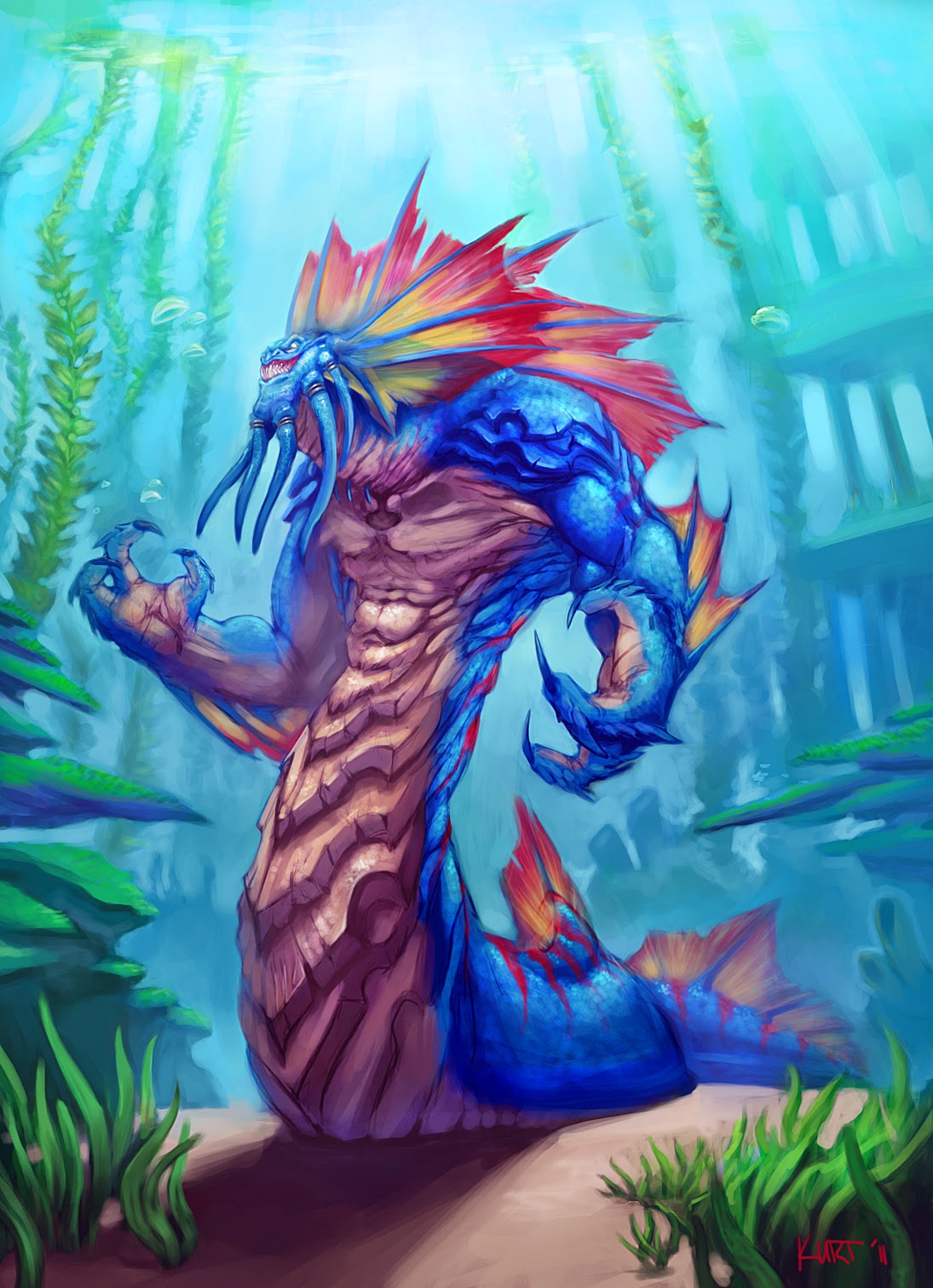
"Welcome to Vashj'ir"
Artwork by Ikameka

The Dark Below

There are only two times in my life I can recall a piece of music that made me feel as if I were drowning.

In 1994, Zoid introduced me to a band named Delerium. I'd describe it as an ambient, almost hypnotic genre of music, famous for layering electronic soundscapes and euro-dance rhythms atop angelic vocalists -- some reaching seemingly inhuman octaves. This side project of Front Line Assembly heads Bill Leeb and Rhys Fulber seemed a more likely extension of Enigma, rather than the industrial sound Skinny Puppy.

Semantic Spaces turned me into a Leeb/Fulber zealot overnight, and in my excessive style, I dove deeply into any other side projects they produced. My research revaled a prolific, multi-volume career: three albums under Intermix, four as Noise Unit, a single-album stint as Cyberaktif, and perhaps most surprising of all, eight Delerium albums preceding Semantic Spaces. These earlier Delerium albums were dark, moody, and in some places, not much more than disparate sound effects (particularly true of Morpheus). Their sound was nothing like what I expected.

Sematic Spaces' follow-up, Karma, paved the way for DJs like Tiesto to help shape a new genre of music: trance. Invoke the name to a fan of the genre, and it will most likely summon up visions of ecstasy-infused glow stick raves at Ibiza. I wager very few Delerium fans will instead conjure up an image of Willem Dafoe, bloodied and nailed to a cross in The Last Temptation of Christ, yet samples of Peter Gabriel's haunting Passion is sprinkled throughout Spiritual Archives, a Delerium album that predates Semantic Spaces by three years.

It is this same haunting music that is ever present in another Leeb/Fulber side-project: Synaesthesia.

A person experiencing this "juxtaposition of sensory information" might taste the heat or smell the silence; even those ravers might feel the rhythm (if they're prone to cliche). Synaesthesia is a grammatical term, a neurological phenomenon, and thanks to Leeb/Fulber, a side-project rich with sonically submerged imagery. Their first two albums, Embody and Desideratum, weren't anything spectacular; most tracks were slow and odd, aka "experimental". But it was their third release, Ephemeral, that the underwater chord was struck.

Naked Sun weaves its hypnotic tentacles into your brain, implanting uncanny impressions that these sounds come from a mysterious and frightening source, many fathoms deep; all the tracks on Ephemeral are like this. Intelligence Dream had such a profound effect on me that I laid it into our High King Maulgar kill video. You listen and cannot help but feel you are sinking down toward the darkened ocean floor. Pardoxically, it is peaceful yet nerve-wracking, and is one of the few times such a distinct image of being underwater came from music.

The only other music to do this was Vashj'ir.

Mature notes consumer interest in his gem auctions,
Vashj'ir

What Goes Unnoticed

What is it, exactly, that Russell Brower, Derek Duke and David Arkenstone honed in on when building this musical landscape? The commonality between Vashj'ir and Ephemeral is subtle yet important. We hear those gongs, low pitched piano strings, granularized and slowly rippling outward in waves, like a ping from some ghostly sonar. Above the surface, air would deaden their duration, but sound waves suffer no such encumbrance under frictionless water.

The strings and flutes repeat their somber melody, two measures of four notes each; they're sad and empty. Yet, listening closer reveals a striking similarity to an alarm in slow motion, repeating its warning, eating into your consciousness, conveying both weightlessness and loss. The music of Vashj'ir is a cascading terror of the deep manifest, and is one of the most unappreciated aspects of Cataclysm.

In what should come as no surprise to anyone, Vashj'ir annoyed nearly every player who quested there. Any recognition of the zone's good qualities, particularly that of the music, was drowned out by focusing on their personal inconvenience. This was truly a tragedy. Lore nerds knew Vashj'ir was coming, knew it had to be completely underwater to be canon, and Blizzard pulled it off. Gorgeous visuals, immersive music, they even adapted our characters to bound quickly across the ocean floor.

Nobody cared.

Complaints flooded the forums about how annoying it was, and how Blizzard was "forcing players to think in 3D" -- as if by some strange miracle we had been playing two-dimensionally since 2004. Whatever little support the Vashj'ir zone received was deafened by the cries of the confounded and the perplexed.

I still love it, as does my daughter, but we are a sad and small minority. As with so much of the World of Warcraft's incredible attention to detail, Vashj'ir went misunderstood and underappreciated.

While Moorawr congratulates Moolickalot and Mature preps
his gear, DoD completes Heroic: Blackrock Caverns,
The Stonecore

This Isn't Canon

Leveling in Cataclysm wasn't a chore. For the first time in Blizzard's history, the expansion only extended our cap by five levels rather than ten. For those unable to withstand Vashj'ir, leveling kicked off in Mount Hyjal. This zone was locked away for years, visible only through a sealed gate that was buried deep in the back of a Winterspring cave.

There were, of course, other...more unconventional means...to catch a glimpse of Hyjal.

Our experience rested firmly within the Terms & Services: via the Caverns of Time, as a 25-Man raid in The Burning Crusade. Aside from raiding and exploits, Hyjal remained all but closed off to the WoW gaming community at large...until Cataclysm.

In the present day, Mount Hyjal was now accessible to all, blown wide open...
...and on fire.

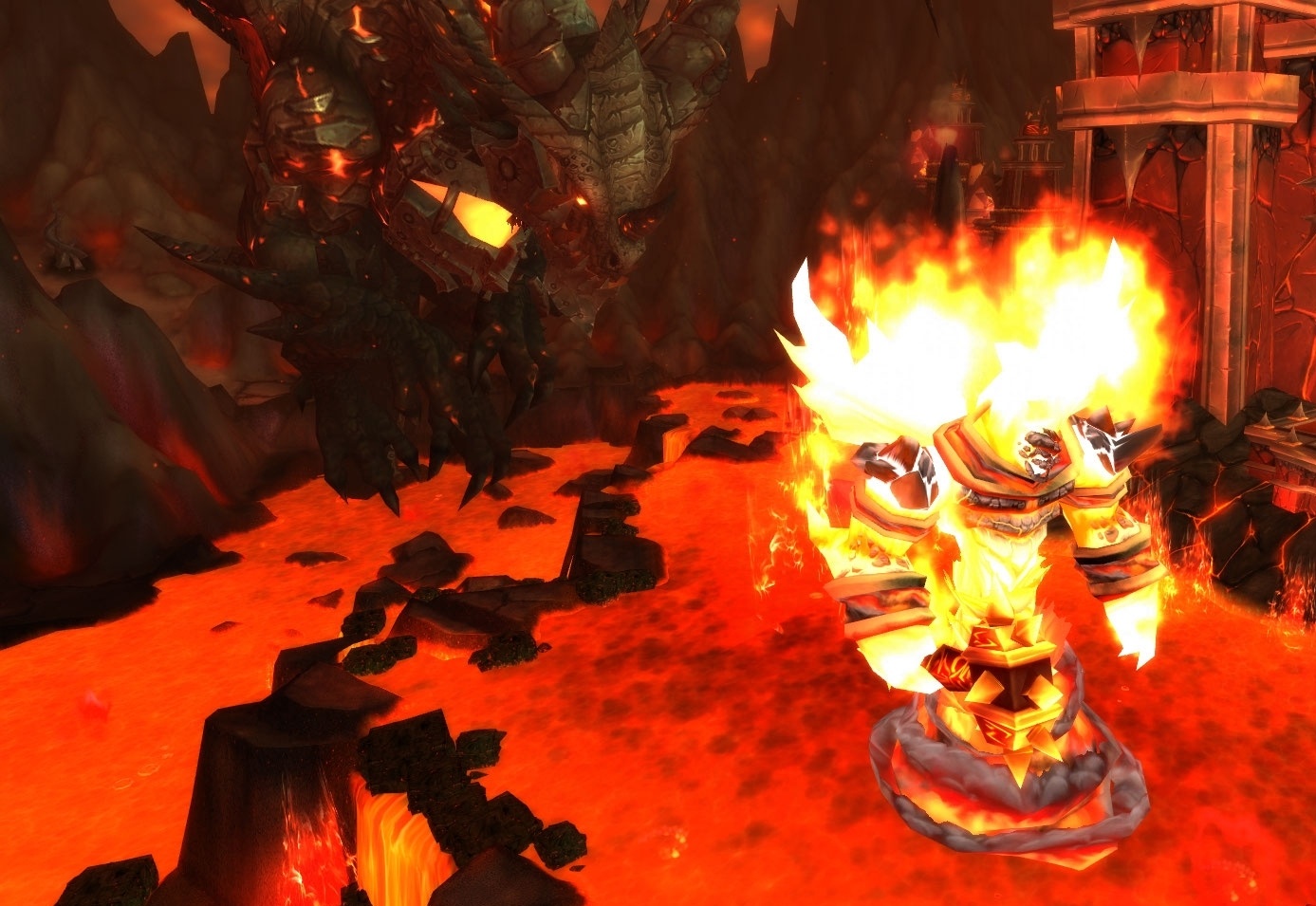
I wasn't surprised to see an old friend emerge from the fire and greet Mature, as I made my way from Nordrassil to Sulfuron Spire. Ragnaros rose out of the flames to greet us with a warning - we were on his turf now. Molten Core, it would appear, was merely a setback.

One of Cataclysm’s central themes was that of the elements, taking us from the depths of the Abyssal Maw to the searing brimstone of the Firelands; from the majestic architecture of Skywall, miles above the surface of Azeroth, to Deepholm, the earth beneath the earth. I remember exploring the ebon rocks and cave formations in this latter zone, weaving Mature in between tiny bits of rock and stone that floated inches off the ground through unseen magic. When you turn your head to the sky and strain your eyes to see, far off in the distance above you, the bottom of the ocean -- the feeling is unmistakable: you are deep within the mantle's crust -- and a long way from home.

From the unimaginable depths of Deepholm, players next traveled to Uldum, another location just out of reach for years. Prior to Cataclysm, the only hint of Uldum's existence was a quest in Uldaman. A titan recording played back references to Norgannon and his discs, leading us to a fractured entryway in southern Tanaris. The great doors wouldn't open and its only exposure was a dark, black hole partially collapsed like a puzzle missing its final piece. The quest ended, and we returned to our Vanilla duties, while the doors remained silent and untouched, throughout Vanilla, TBC, and Wrath.

No longer.

We rushed through the now open gates, inviting us into a land inspired by Egyptian themes, hieroglyphics, and bizarre humanoids one might mistake for centaurs...if it weren't for their predominantly cat-like features. Uldum also buried secrets of a dwarven nature, and if Uldaman and Ulduar were any indication, those secrets in Uldum would hopefully wrap up unanswered questions. What of Norgannon's discs, and of the titans? What other Earthen spawned here and evolved into the dwarves that populate Azeroth today. And perhaps the biggest question of all: Why Azeroth? I geeked out in preparation for the final chapter of the three ancient titan cities, and couldn't wait to get started, arriving in Uldum three days after launch.

Two days later, I hit level 85 while handing in a quest in Uldum. I finished what remained, and never returned to the zone. No questions were answered, no great titan cities were exposed, no secrets revealed. I spent the majority of my time chasing Brann Bronzebeard who seemed more like a loose end left from Ulduar that a core piece of narrative driving the Warcraft story. The only connection to the titans, it appeared, was that these cat-taurs, the "Ramkahen" were left behind by the titans to guard their secrets.

What secrets?

No earthen or dwarven history was made mention of. In their place stood these cat people, tending to fields among the sands. There was no Norgannon. No Khaz'Goroth. No references to Algalon or anything of his kind -- nothing. If Uldaman was the appetizer and Ulduar was the main course, Uldum ended up a very disappointing desert.

Friday, December 12, 2014

4.18. Minmaxxing

"Deathwing"
Artwork by 陈晨巍 (可奥拉夫)

Cataclysm

Cataclysm launched at midnight on December 7th, 2010, and within 24 hours, Blizzard began backpedaling. With any software launch, bugs are bound to pop-up. Ask any player that's been present for Blizzard's major game launches and they'll tell you it's often a storm of chaos and confusion. Servers buckle, LUA errors appear on the screen like advertisements, and players wait at the character selection screen, the "Logging in…" message never quite delivering on its promise. Eventually, bugs are fixed, servers are rebooted, and the World of Warcraft resumes its quiet hum.

Fixing code that malfunctions is what's needed when results do not line up with vision. Designers govern the rules; to them, all the World of Warcraft's a stage -- the programmers, artists, and musicians are merely players. If designers decree that "the world should turn from day to night in real-time", is a rapidly-cycling sky truly a bug? Well, if the previous rule was to spin the sun and moon like a top, then technically, no, it is not -- but it is also not behaving as intended. These are the three words programmers focus on when determining what is broken and what needs to be fixed. Bug fixing is never an existential question to a programmer; code fails to meet requirements, and therefore must be adjusted. But the requirements define the boundaries of what's expected and what's not, and those rules come directly from the designers.

In a sense, designers have the power to will bugs into existence.

Let's be realistic, here: we're not talking about magically causing the game to crash...we're talking about defining what's allowable yesterday vs. what's allowable today. When the game doesn't behave as intended, it's the designers' intentions we are talking about.

---

The collector's edition arrived at my door around noon on the 8th. Within a few minutes of tearing into the packaging, I had the serial number attached, and was logged in, ready to get started on my path to 85. By this point, Cataclysm had only been live in North America for around twelve hours, yet the re-designing was already in motion. Guilds of every shape and size, of every dedication level from the ultra-casual to the most extreme of hardcore, were noticing their Guild XP levels backed up like a stopped toilet. A blue post from Nethaera explained the stoppage:
We have decided to remove the added bonus of gaining Guild Experience from Guild Achievements earned. This change will realign Guild Achievements with our philosophy held for normal Achievements, which are intended to be predominantly their own reward (barring the rare exception of special achievements that grant an additional reward.)

During the beta, we greatly increased leveling speed across the board and since most characters were copied from templates, guild experience from Achievements didn't seem imbalanced. It has become clear that an imbalance does exist and should be addressed to ensure that guilds progress at the rates expected within the daily Guild Experience limits.

For guilds that are currently above the normally possible experience limit, we will be readjusting it back to the expected limit once more. This will not affect Guild Reputation gains at this point in time.
Translation: we were consuming content too quickly.

Mature takes a group of DoD through one of
the new 5-man dungeons in Cataclysm,
Blackrock Caverns

Good to the Last Drop

One could argue that their original weekly caps were intended to curtail this behavior, long before the game launched. But it was never really clear what those caps were; even the Elitist Jerks weren't certain. WoW historians/nerds will point out the very real post made on the EU forums, indicating in bright blue text that some guilds were indeed leveling past the cap for unknown reasons, fulfilling the aforementioned requirements of a bug:
Unfortunately, due to an error, some guilds have been able to gain more experience in the first few hours of Cataclysm than was initially intended. Your guild is one of those affected and as a result, has had the guild rank moved back to level 1. This has been done to all guilds that had this issue.

The reason for this is that guild experience has been intentionally capped at a certain amount a day. Tomorrow you will once again be able to gain experience as normal.

We apologise for any inconvenience this has caused you and your guild. The issue should now be fixed so this will not be a recurring issue.
The game, as perceived by the European crowd, was not behaving as intended.

But, without knowledge of the official weekly reputation cap values, combined with how much personal achievements actually contributed to guild experience, no one could definitively say whether or not the changes were truly the result of design decisions gone wild. What we do know are the results: that very early into the morning of December 7th, across the ocean, the hardest of hardcore guilds were well into 3rd guild level before they saw it magically back itself down to 1, freezing in position only hours later.

When I logged in at noon on the 7th and pulled Lil' Deathwing from my mailbox, Descendants of Draenor was already capped for the week; I'm sure many other guilds were as well.

Well, the large ones were, at least.

Perhaps the smaller, more casual ones took the rest of the week to hit their caps -- but many managed to squeeze it in. By Tuesday, we were all back on the same page, all equal in the eyes of the designers once more.

Most don't remember nor care about a change as trivial as this, a hotfix rolled out in the early hours of the morning of Cataclysm's launch. It was just another bug fix, all part of the launch process -- many bugs are fixed during launch. Caps were in place to keep the content gated, and for progress to move at a distributed pace. Move on with your life.

All of these explanations make sense, but aren't answers to the question at hand.

The question is: what was it about this bug that caused it to be perceived as imbalanced in their vision?

17 hours and 11 minutes after Cataclysm's launch,
Gunsmokeco becomes Deathwing-US's first level 85 Shaman,
Blackrock Caverns

Cataclysmic Converter

Seventeen hours after the launch, the guild glanced down at their respective chat windows to see an incoming realm announcement:

Gunsmokeco has earned the achievement [Realm First! Level 85 Shaman]!

The long term vet of DoD had slaved out a 17-hour all night session, attempting to beat out every other shaman on Deathwing-US at their game. Guildies snapped screenshots and congratulations were spammed toward the exhausted but victorious shaman. When asked why he did it, Guns simply replied, "Dunno if I was gonna get the chance again, so why not?"

We don't put enough value in how important it is to be able to play as much (or as little) as we want; ask any casual WoW player what they think of being forced to play beyond their means. I doubt many would argue that Vanilla imposed an artificial minimum amount of hours necessary per week in order to see any real in-game progress. It isn't until we opine on what an appropriate maximum should be that the opinions of us old-schoolers begin to diverge, even Gurgthock felt most guilds raided too much, back in the day. This vision was borne of a very old-school (and hardcore) way of thinking about content: accessing it is a privilege, not a right. You earned your rewards through concerted, concentrated effort. Just like anything in life: practice makes perfect.

From a hardcore perspective, it makes complete sense -- from a business perspective, it makes none.

Throughout the years, design decisions conveyed a more accessible vision, one that diminished the importance of that artificial minimum. I hold that nearly all of them were the right decisions: alternate currencies to purchase welfare epics in TBC, alternate smaller raid sizes facilitating easier coordination/execution in Wrath. These were the kinds of quality-of-life tools necessary for players with reduced schedules or alternative preferences in play...but took nothing away from the hardcore gamers, who could earn the most glorious rewards in the blink of an eye.

The investment needed to progress withered away, conveying the message loud and clear: eventually, you will earn your way toward victory. Players were then free to choose how little or how much they devoted to the game. I followed suit with DoD and rewarded my own members in kind: you won't be punished for not meeting a minimum -- there is no minimum.

As for maximums, we'd seen them before: the weekly cap of honor points, the monthly-gates that slowly revealed deeper, more challenging encounters in raids, and these systems served their purpose. Regardless of whatever spin is put on the "official" statement, we can nearly all agree that the intent of gates were to extend the life of the content. If you could burn through it all in one session, what would be the point of coming back? Or going again? Or renewing your subscription?

What caused Vanilla players to come back, in a World of Warcraft devoid of gates?

For me, it was the challenge and the community. I came back to Vanilla, night after night, because we had more content to work on and it was thrilling to work on that content with the people of DoD. And back then, WoW barely had 5 million subs; we were more than double that by the end of Wrath. Surely, community should have existed in spades and the coming raids were not going to be as easy as those of Wrath. It seemed counterintuitive, then, for Blizzard to begin imposing caps on how fast we chose to consume content on day one -- the speed at which we chose to dive into WoW never affected our subscription before, so why would it now?

If they were so concerned about us feeling obligated to play a minimum each week (then fix it), what compelled them to dictate how much we played?

Allow me a slight rephrasing to quash those who might think I’m about to accuse Blizzard of acting solely out of greed:

What non-monetary reason exists to force a customer to consume goods at a restricted rate, if the quality of the products has remained the same?

Thursday, December 4, 2014

4.17. Sculpting Clay

Mature watches the city of Orgrimmar burn
as Deathwing lays siege to Azeroth,
Durotar

The World Breaks

Tremors shook the ground, elementals burst forth from crevices, ravaging cities and villages as players led the charge to drive them back. Mindless chants of the Shadow Council filled the streets, their bodies adorned with sandwich boards advertising the end of the world. Some of us had already caught a glimpse of the beast. It began as a dark shadow whose awesome presence blocked out the sun. You'd turn your attention to the sky, searching. There, you'd catch your glimpse of a colossal wingspan, blades fanned out revealing the magnitude of the situation. And by this point, it was too late. The blackness of leathery, melted wings slowly turned blood red, which was about the moment a realization set in -- you were burning alive.

Players yelled out idiotic cheers in /General as Deathwing burned them to a crisp, excited that their demise had been rewarded with a sparkling new achievement. Mature stood outside the Horde city of Orgrimmar, and we watched the great city burn while the masses celebrated their first achievement for failing.

On the other side of the screen, we had some real milestones to celebrate. Descendants of Draenor completed its sixth year of activity, and I rewarded the guild with a brand new website. After months of uploading photos, configuring new DKP pools, testing XML imports from raid dumps, and obsessing over geeky content management system configuration options, I introduced my players to the new face of DoD, powered by eqDKP-Plus.

The guild dove in, updating their profiles, importing their character sheets from the WoW Armory, personalized their email alerts and raid schedule notifications, and got a chance to check out the slick integration with achievement histories and World of Logs reports, right from the homepage. I listened in Vent, watched guild chat unfold, and waited to see what the first comments would be when they discovered the image gallery.

"Wow, you wrote a description for every single screenshot in here? God, how long did this take?"

It took as long as it needed to.

---

Our six year anniversary also marked the eve of the third expansion, Cataclysm. With it, came the promise of new game mechanics, a new level cap of 85, and a broken world to explore. As it was with Wrath of the Lich King and The Burning Crusade before, the changing winds of the game meant DoD would need to adjust its direction as well. The months between the defeat of Arthas and the arrival of Deathwing were spent collecting data, reviewing loopholes, talking to guildies, and consolidating all that I had learned in my six years as guild leader. Once the guild had a chance to enjoy the new website, I pulled back the curtain on what was in store.

The new face of DoD - www.descendantsofdraenor.com,
which runs atop the eqDKP-Plus content management system

Marching

To begin, I raised the minimum age requirement from 21 to 23. Instituting an age requirement at the start of Wrath provided a much needed balance to the atmosphere of the day-to-day. I never intended it to curtail immaturity, rather, it put so many more of us on the same level. That did wonders for alignment; we spoke the same language, had the same goals, shared the same beliefs. Bonds were much stronger than before.

I toyed with requiring Authenticators early on, to decrease the impact on the guild bank when a hacking occurred. Once Blizzard tied the actual acknowledgement of Authenticators into guild management, I was able to flex this requirement slightly. In Cataclysm, guildies didn't need to have an Authenticator...until they reached a rank where they were dipping into the guild vault extensively to procure mats for flasks, gems, food, etc. There was no sense imposing the "perceived additional annoyance" on players. As before, I empowered them to choose how far up the ladder they wished to climb; it was up to each player to decide if the perks were worth the additional account security asked of them.

Another change I made for Cataclysm came in the form of how I acknowledged referrals. In Wrath (and to a degree in TBC), I hammered home the message that each player was "selling the guild". Every time they stepped into a random dungeon, or ventured into /General, what they said and did reflected upon us. Many of our recruits had come our way via this mechanism; players simply being impressed at how respectful DoD was toward complete strangers. In Cataclysm, I intended on rewarding players with a finder's fee. If their referrals eventually hit a particular rank, they would see a monetary payout as a way to thank them for investing in their guild. It wasn't much, but I wagered several hundred or even several thousand gold might remind guildies how important those referrals were to us.

All of these changes seemed to go by without much notice, but once DoD put their eyes on the changes to ranks and raiding rules, opinions came out in full force.

Elites were gone, and with them, the guaranteed spots in the raid that came with the title. This was perhaps the most noticeable, most invasive change I employed for Cataclysm. "So, nobody gets a guaranteed spot anymore?" No. "So, what's my incentive to raid in the 25?" Consistent rotations. "But isn't that just another way of saying it's a 'guaranteed spot'?" Actually, it isn't. "What's the difference?"

The difference is that one is burdened with the demand of continuous effort, and the other...is not.

The high-end raider of DoD is a player constantly striving for greatness, yet intimately aware of how fleeting their position is. All it takes is for their effort to wane, their attention to drift, and their attitude to sour for a change in rotations to blossom. The Raider/Elite rank system worked well in Wrath, showering the most dedicated players with the greatest perks. It solved the problem of the double-standard, keeping scrubs from reaping the same rewards as the star performers, pulling progression down into the gutter. But, it failed to hold those star performers accountable for their actions once they climbed up on to their respective pedestals; they became untouchable. And while some epitomized the type of role model I wished the entire guild would model themselves after, for others, the title became a self-fulfilling prophecy; their aloofness and grandeur led them to speak in ways that disgusted me, and justify decisions that violated any sense of morality I aimed for.

Take note: language matters. Assign something a label, and you may soon find that everyone believes it to be true...especially if the thing is a person.

In Cataclysm, I removed guaranteed spots in raids. Players who set the greatest examples, provided the deepest insights, and contributed the most value to progression would earn spots that were the least temporary.  Furthermore, there would be no more large groups of players dominating the upper echelon of indignance. Instead, only one of each class would earn that coveted place whose spot was nearly guaranteed. These were the self-motivated players, the ones requiring little (if any) guidance, and consistently made the right decisions. They were the humble amid success, ever aware that a wrong move could cause a fall from grace.

These individuals would come to be known as the Saints of DoD.

Mature joins the server in defense against
the encroaching Elemental attack,
Orgrimmar

A Trilogy of Trickery

"There are three types of people in the world," the words on the screen explained, "Saints are those that strive for greatness without intervention, and require little management from you. They're always accountable; they always deliver. Perhaps they're fundamentally good people, or they're the right fit for the team -- but whatever the case, they make you look good as a leader...whether you deserve it or not. Reward them and protect them; you don't want to lose them."

I read on.

"Sinners are on the other end of the spectrum. Excuses flow from them like water from a fountain, and can never be counted on to deliver or improve. Maybe they're bad people, or bad hires..."

Or bad players.

"...but they will make you look bad as a leader. Whatever few sinners you come into contact with, make sure you get rid of them if they're on your team, and don't hire them if they're potential candidates."

I sipped my coffee and continued.

"Saints and sinners are a fraction of who you'll encounter. Your attention, therefore, should be focused on most everyone else. They must be molded and shaped, as if sculpting a statue from clay. They are not throw-aways, but they do require investment. With the proper measures in place, you can empower this vast majority to do great things, meet (or exceed) expectations, and cause your team to be an overwhelming success. These are the 'Save-ables', and they are the topic of this book."

"Sometimes save-ables make the right decisions, sometimes not. They'll become an active, quality contributor to your team if the right conditions are met. To know how to put those guardrails in place, you must first understand that save-ables are human beings, vulnerable to the evolutionary wiring established long ago. Specifically, they possess three traits you'll want to pay attention to: They can't read your mind, they're frequently delusional, and they're selfish."

I liked where this was heading.

"Not making your expectations clear and credible equips your followers with all the excuses they need to not perform. It may sound silly to admit, but your team won't know your intent unless you tell them, and you must do so in a way that is unambiguous. Clarifying the modus operandi isn't something you get around to after the work is done...it is the work."

Nice to see you figured this part out, at least. An old lesson, one that helped change the course of our failures in TBC. Everybody showing up to the party, each with their own definition of "fun". Making sure they all knew fun meant "constant, consistent progress" was the first step in turning that boat around. I read on.

"Humans lack the ability for honest self-assessment, a result of our evolutionary wiring. Quick thinking defensiveness saved us from saber tooth tiger attacks, but predisposes us to a self-important agenda. And when we're self-important, it's easy to credit ourselves with successes, while pointing fingers to others for faults. Delusions of a magical land where no one is at fault are suppressed when you ground yourself in empirical reality -- the things you verify with your senses. When you lead by speaking the honest truth, your followers will do the same."

In a single paragraph, the author nailed exactly why folks like Blain were able to enjoy such success in leading -- by speaking the truth. Some people don't want to hear it, but its sets the precedent for thoughtful discussion and debate, rather than finger-pointing and excuse making. The raid team learned quickly that bullshit wouldn't go far with him.

I agreed with the author of the first two counts, but had already learned both these lessons. Perhaps the third would provide insight.

"In our context, selfish doesn't necessarily mean bad. It simply means that humans naturally act with their own self-interest at heart. It is not from the benevolence of the butcher, the brewer or the baker that we expect our dinner."

I didn't doubt it. "We're here 'till the end, Hanzo!"...remember that? Translation: we're here until it's no longer convenient. Until the loot stops rolling in. Never forget how many of your "chums" are the friendliest of the bunch as a means to ensure their own foot stays solidly wedged in the door. So, what was the book's insight into keeping these self-interested folks on the road I so diligently paved?

"Compelling consequences are necessary to keep your team producing the positive outcomes you intend. Whatever you're rewarding or tolerating, you can bet that your save-ables will give you more of it. Whether positively or negatively, you have a lot more power to influence them than you might think."

Always the softie. You should've tightened the noose long ago. I flipped back to my rules, scanned until I hit the 1st round bidding explanation. There was really no reason for me to be mad. All the explanation that was needed was right there in front of my face, seared into the rule itself. My loot rules were exploited because there was no reason not to; the insignificant cost paid by the winner allowed for it. I allowed for it.

An email alert popped up, turning my attention to the guild management forum. A few hours earlier, I'd laid out the details of the Eh Team "loot collusion", revealed to me by Bheer, along with the notes of my various interviews with the members. The officers were disgusted, and wanted to know what would be done to punish the offenders.

Stripping players of their ranks and spreading the story of their bad judgements to the rest of the guild all seemed more justified, by comparison -- but wouldn't give me any new results. Even if the individual members of Eh Team were to all exit stage right, what was to stop a new generation of Eh Team from filling their shoes? Individual punishments wouldn't give me the behavior I wanted...only one thing would.

"We'll be making 1st round winning bids empty their DKP pool."

I submitted the post, then returned to my reading in the window labeled Leadership Without Excuses.

Thursday, August 7, 2014

4.1. The Beginning of the End

Part IV: Cataclysm

"Great countries have fallen under less tyrannical rule than what you impose upon this guild."

World of Warcraft login screen,
during the Cataclysm ('11-'12) era,
Copyright © 2012 Blizzard Entertainment

We Meet Again

Doubt.

It's you again, old friend. That infection of the mind I just can't seem to shake. Battle scars from our former meetings are extensive. Whenever the biggest risks come to the table, when I have the most to lose, the marks are a reminder that I fought and won. You knocked at the door when I decided which guilds to assimilate and which to ignore. You had Graulm and Ater on a first-name basis at a time when it wasn't especially clear where my loyalties should lie. I remember you being clingy when it was time to shift out of AQ40 and into Naxxramas, leaving the bug-ridden instance unfinished.

You were out of sight for a bit, back when I thought I was untouchable. You got your little jabs in when I lost folks in Karazhan, when we took weeks on Magtheridon, when we wiped an embarrassing amount of times on The Lurker Below. I have to hand it to you, you've got spunk. You're like every man's personal forum troll and hater rolled up into a convenient little package. When my main tank and mentor left the game, there you were, with your sympathies that reeked of "told-you-so".

You were practically my copy-editor when it came time to rewrite the guild rules, my own personal YouTube commenter. Every word I typed was a joke to you, and you were certain to point a finger and laugh when I left loopholes for people to exploit, shirking morals in their illustrious rise to power.

You're tenacious -- if but a bit predictable. Didn't see you come out to congratulate us on all the bosses we dropped, and you certainly weren't there to pat us on the back as we took on the competition without losing players. See, that's the tricky thing about you. You don't really like to show your face when you're on the losing end of a debate, when you've been proven wrong. You linger, hovering over my shoulders when I know I'm about to make a decision I'll regret. But when that decision turns out beautifully, you're nowhere to be seen. How convenient that must be. You take off when things don't go your way; I can practically set my watch to it. Which begs the question: why are we squaring off again today?

The end of Wrath is only a few months away, and we've cleared nearly every boss in both normal and heroic mode. My guild is made up of some of the best played, best geared folks on Deathwing-US. Everywhere I turn, I see the Descendants of Draenor guild tag, so many well-known and accomplished folks on the server. They're already deep into the planning stages for Cataclysm's raid content. From all angles, we've nailed it, chief. And so, old friend, this is the part that confuses me, because under any other circumstance, you'd be as far away from this success as possible. Under what guise do you feel you still have authority over me?

I couldn't shake the feeling I had seen this all before.


A comparison of hit combo values between
 Street Fighter Alpha 2 (above) and Marvel vs. Capcom 2

No Scrubs

"Daaaaamn, you just got royally fucked up!"

"Another? That quarter yours?"

"Bullshit. And yes, I am going again. This fuckin' stick is busted."

The kid next to me dropped another coin into Street Fighter Alpha. The joystick movements hadn't changed much through the iterations. Ken had pretty much always been Ken, right from the first quarter sunk into Street Fighter II. Since then, Capcom rode the gravy train to success, rolling out sequel after sequel. Street Fighter II: Champion Edition let us choose the same character for hot Chun-Li on Chun-Li action, Super Street Fighter II added four new characters. Trip Hawkins made a horribly expensive console that I wouldn't have dreamed of purchasing, had it not been for Super Street Fighter II Turbo. Which led us to this prequel in the franchise, taking place before the events of the game that originally hooked me. I dug Alpha, and was particularly fond of the alpha-parry system, turning an opponent's attack into a block-counterattack in a swift 1-2 punch. With it, I could be on the offensive, even when on the defensive.

Hadoukens and Shoryukens glided out smoothly, muscle memory from years of performing the quarter-circle and zig-zag motions mapped to their respective abilities. I held the joystick with the tips of my fingers, believing it to give me a slight edge in precision. "Underhanded" was another popular style: the hand is turned upside down, nestling the joystick between middle and ring fingers. It was easy to size a player up that chose either grip: they knew their shit.

My opponent backed into the corner, nervous, waiting to see if I'd unleash another barrage. I snuck a glance without moving my head, trying to get a read on whether he was about to leap forward: the subtle nervous shake in a player's hand before his next move. The move that gives him away. He gripped the joystick with a fist, as if to pound a nail into a board. His movements were jerky, panicked, and he looked to tear the stick right out of the casing at one point.

Scrub.

He made his move, telegraphing the Titanic in the process. As he leapt, I caught him with another Shoryuken. He hopped off his back just in time to get a foot in the face, which I chained into several jabs, a low sweep, and a final Hadouken, sending him flying backwards through the air in slow motion. The screen read "5 Hit Combo Finish".

"Thanks a lot," he said, as if to imply we were taking turns trading wins -- a common tactic to make your quarters last longer. Quarters among friends. I didn't know this guy, or his pal...the one who spoke next.

"What's the highest combo you've ever got?"

"Ah, Christ, no idea. 11, 12 maybe? I can't even remember the last time I got into the double digits. The timing is insane." I was good, but not that good.

The guy I beat puffed out his chest, "I nail 30 hit combos all the time in MvC." I glanced over my shoulder at the Marvel vs. Capcom 2 machine. MvC took the SF franchise in a drastically different direction. Playing off the licensing behemoth of Marvel Comics, Capcom facilitated a tournament of infamous faces from their games, pitting them against super heroes I'd known since childhood. Matchups like Venom vs. Mega-Man, Spider-Man vs. Captain Commando, and Zangief vs. The Incredible Hulk were now a reality. The collective star power was unparalleled in MvC, and it drove some mad lineups to the arcade. For a time, at least. Players soon got wise to the gimmicks.

From the moment a seasoned SF player cast their eyes on the four buttons, something was amiss. Every SF game in the franchise delivered the standard six-button layout... but not MvC 2. Technically there were six, but two "assist" buttons masqueraded under the familiar layout. What was once a tried and true system, was now ever so slightly watered down. There was more.

The game diverged from its Street Fighter brethren in its over-the-top combos system. Basic joystick movements coupled with button presses yielded instant double-digit combos. Chaining these abilities together, then, caused ridiculous numbers to spin up. The average player rocked out with these Hyper Combos. A seasoned SF vet knew better.

MvC gave you the illusion you were doing better than you actually were. Comparing a 30 hit combo in MvC to SF was ludicrous, unless you scaled it appropriately: ratios varied from 1:8, to upwards of 1:30 in the most bizarre cases. Was the game less fun as a result? On the contrary, MvC was an absolute blast in terms of entertainment. It was easily the most stylish one at the party, and had plenty to go around.

Ah, but the substance...

You came to expect certain things from the SF franchise: Ken's red, tattered gi, Chun-Li's hair done up into two buns...and scoring a combo in the double digits took practice, patience, and timing. The numbers lied to you. With MvC, anybody could hit the double digits, and those who gloated were the least qualified to understand why it didn't matter.

"MvC is way easier than Alpha....game's insane!" one of them spoke, trying to sell me on the adrenalin. My eyes darted to the kid and his proclamation, then back to the MvC 2 cabinet. It stood alone, ignored. Yeah. 'Crazy fun'...that's why everyone is knocking down its door to play. On its release day, MvC had a lineup of kids walling me off from the machine. The jig was up.

I turned back to Alpha, the announcer's voice barely audible against the backdrop of relics that lined the room.

The 25-Man progression team takes a photo
on the back of their respective mammoths,
Ruby Sanctum

Identifying With Neither

I sat, staring at the monitor, not knowing what to type, not knowing what approach to take. The document title stared back: Descendants of Draenor - Changes in 4.0. The cursor blinked on the plain white screen. I was at a loss. What's your strategy, chief? How exactly do you plan on getting people to stay? I didn't know. No matter the angle I framed each possible solution, a logical solution failed to present itself. Antisocial players submerged in mediocrity would have no incentive to grow. Not with the back door left wide open by our friends in high places.

A week earlier, screenshots of the 25-Man raiders floating above Dalaran on their Frostbrood Vanquishers went live on the forums, signaling our last great accomplishment in Wrath. Plenty of time remained on the clock, if we so chose to eek out Heroic Lich King, but people wanted their gear, wanted to finish off their Tier 10 four-piece bonuses. Some would want breaks, gone for the summer months. And they'd earned it. Pushing Heroic Lich King ran the risk of burning players out, discouraging them from returning. Better to give them a breather now so that they could come back refreshed later, ready to pound the virtual pavement. If a tactic had the remote possibility of regenerating stamina in the roster, I had to employ it. We'd need every last drop.

From the moment it was made public, Blizzard's announcement of merging the 10-Man and 25-Man raids into a unified lock never left my mind. I carried the baggage to and from work, and played WoW like a zombie, contemplating possibilities. Each time I thought I had it, nope...that simply won't do. The back door is wide open. After the propaganda of the Blizzard PR machine settled like so much dust, one fact remained perfectly clear: once a guildy made a choice to run a 10-Man each week, they'd be systematically locked out of contributing to the 25. It didn't help that both sizes now shared the same loot tables, but Blizzard even went so far as to claim that the difficulty would remain the same between both sizes. It was an absurd claim. Most preposterous of all: Blizzard claimed to be returning a level of difficulty more in line with The Burning Crusade. It didn't take a genius to determine how this would play out.


  1. WoW would become brutally difficult.
  2. 7.5 of the 12 million WoW players, groomed on the Wrath content, would very quickly get a wake-up call -- having never known the way things were.
  3. They would do the napkin math in their head, and leave the 25s behind, joining the far more digestible (in theory) 10-Man content.
  4. Without a healthy pool to pluck from, the 25s would collapse.

Players...guildies...would choose the path of least resistance. No offense, old-school raiders, this was a simple reduction of risk. How could I convince them otherwise? Players owed the guild nothing.

They owed me nothing.

Sure, some people might stay. I wasn't happy with 'might'. Lessons learned from Vanilla and TBC proved to me that reliability wasn't built on good intentions. You had to provide structure, rules, and a system that acknowledged and rewarded players for their contributions in order for them to make the right choice. All the structure in the world didn't account for this new threat. Part of being in the DoD team meant you were never done learning, you were willing to grow, improve, seek new ways to be a better player, a better person. What if at the end of the day, all you wanted was some phat lewts and to not have to deal with people? To not have to be told you need to shape up. Your heals need work. Your DPS is at the bottom of the charts. You're dying in the fire too much.

You're failing. Fix it.

So, given the option of taking criticism or not taking criticism, how could one hope to keep this Mediocrity Swim Team pushing for the gold? The casuals would flock together, frolicking across the land without a care in the world, while the hardcore, 5-day-a-week raiding crowd would demand excruciatingly skillful guilds as their base of operations. Where did that leave us? As I stared at the empty screen, unable to type anything, unable to even begin to guess at what the answer might be, an upsetting reality set in...

For the first time in my career as a guild leader, it wasn't doubt in myself that I feared stood in the way of our success...it was doubt in Blizzard.